Tianyi Sensor IOT Technology Co., Ltd
Sales Manager:Ms. Emily Wang
Cel,Whatsapp,Wechat:+86 15898932201
Email:info@fengtutec.com
Add:No. 155 Optoelectronic Industry Accelerator, Gaoxin District, Weifang, Shandong, China


Sales Manager:Ms. Emily Wang
Cel,Whatsapp,Wechat:+86 15898932201
Email:info@fengtutec.com
Add:No. 155 Optoelectronic Industry Accelerator, Gaoxin District, Weifang, Shandong, China
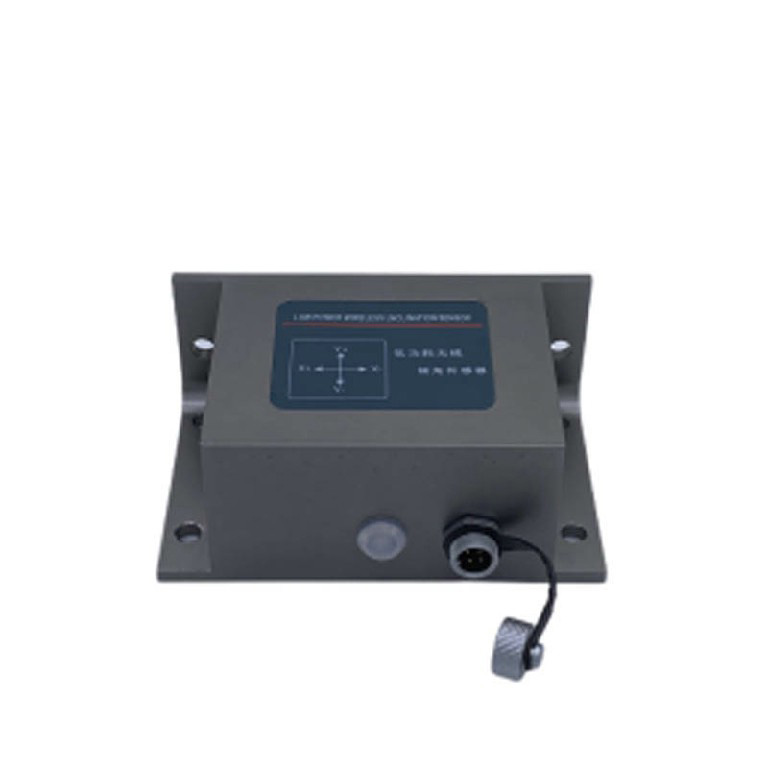
Model:FT-QJ3
Brand:tianyi
1.Introduction to Wireless IOT Inclinometer Products
Wireless IOT Inclinometer enables monitoring of inclination and horizontal displacement, which can be used in industries including geotechnical technology and structural health.The low-power wireless inclination sensor and wireless inclination meter are a high-performance, highly integrated intelligent low-power product.It is a tilt angle measurement device based on NB-iot narrowband Internet of Things and 4G/GSM transmission.It has its uniqueness, innovation and high integration.This product uses the latest Internet of Things wireless chips with the Internet of Things platform, and is equipped with the IoT cloud platform to realize remote data acquisition, monitoring, analysis, inspection, alarm, classification, geolocation positioning, data report curve download, and mobile phones and other mobile devices APP software to realize monitoring and alarms anytime, anywhere.It adopts the standard MODBUS/TCP standard communication protocol.This product is centered on a microprocessor and can reliably realize the acquisition and processing of inclination angle, horizontal displacement, power and other signals, and can realize the functions of timed data reporting and triggering reporting.
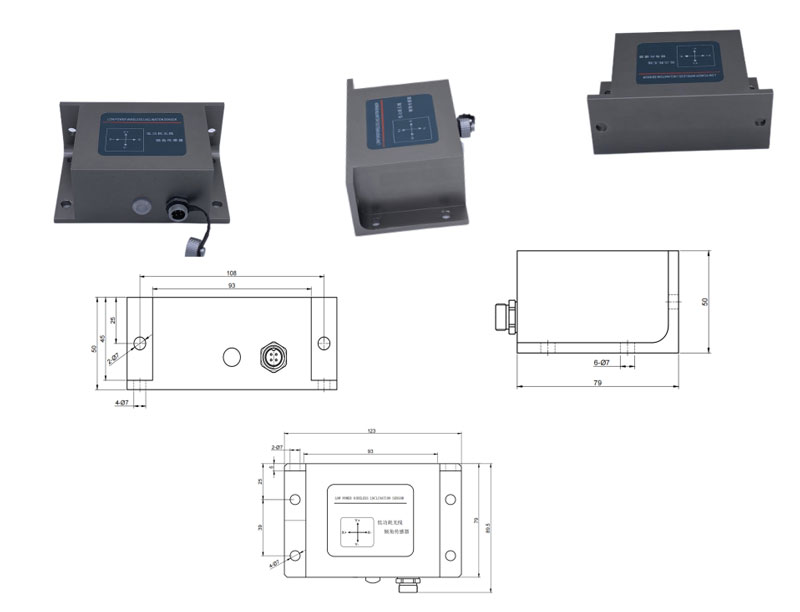
2.Wireless IOT Inclinometer appearance size
3.Main features of Wireless IOT Inclinometer
Biaxial inclination detection
Range ±30°
Output interface RS485
Operating voltage DC3.6V
Timely reporting and trigger reporting
Accuracy 0.01°
With its own horizontal displacement calculation function
Resolution 0.001°
Response frequency 100Hz
Seismic resistance >20000g
Wide temperature operation -40~+85℃
Protection level IP67
4.Wireless IOT Inclinometer application field
High voltage wire tower monitoring
Railway locomotive monitoring
Comprehensive Pipe Gallery
Ancient trees, electric towers
Subway tunnels, terrestrial disaster slopes
Bridge and foundation pit measurement
Houses, ancient buildings
5.Wireless IOT Inclinometer Technical Parameters
| Range | Inclination angle ±30° |
| Number of measurement axes | Dual axis (X/Y) |
| Accuracy | 0.005~0.01° |
| Horizontal displacement | Built-in solution |
| Network style | NB-IoT (B1/B3/B8/B5/B20/B28), 4G GSM full network access |
| antenna | Built-in |
| Sampling interval | Can be set at will, in seconds, if real-time acquisition is required, set to 0 |
| Upload interval | Can be set at will, in minutes, as fast as 1 minute, if you need to set it online in real time to 0 |
| Wake-up mode | Timing, trigger alarm wake-up |
| Configuration Mode | Local configuration/remote configuration |
| Upload information | Inclination angle, horizontal displacement data, battery information, network status, self-test status, signal strength, alarm information, etc. |
| powered by | 3.6V@19Ah one section + one section supercapacitor, external power supply can be selected |
| Power consumption | Standby current ≤50uA, average transmission current ≤100mA |
| Operating temperature | -30℃~70℃ |
| Storage temperature | -40℃~85℃ |
| vibration | ≤3g/10Hz...150Hz (IEC 60068-2-6-2007) |
| Protection level | IP67 |
| communication | RS485 |
| Housing material | Aluminum alloy shell |
| Installation method | Horizontal installation |
Precision Snow/Rain Gauge is capable of monitoring all types of precipitation—including liquid, solid, and mixed solid-liquid phases. It features a real-time precipitation intensity measurement range of 6 to 1800 mm/h and a cumulative precipitation range of 0.2 to 1500 mm, with an RS485 inter...
Equipment Leakage Current Tester detects AC leakage current without contact with live parts, using an inductive electric field. It features three sensitivity levels and can operate in environments ranging from -30℃ to 50℃, making it suitable for leakage detection in natural disaster relief,...
Although traditional mechanical wind speed and direction meters have, to some extent, met basic requirements, they have limitations in terms of accuracy, response speed, and reliability. With the advancement of technology, the 3D Ultrasonic Anemometer based on the time - difference method has been d...
Water quality monitor system for drink water is a water quality analysis device that integrates multidisciplinary technologies such as sensor technology, automatic control, and data communication. Its core monitoring parameters include residual chlorine, pH, water temperature, turbidity, and conductivity. This device is widely used for online continuous monitoring of water quality in various scenarios, including urban and rural water treatment plants, water distribution networks, secondary water supply systems, end-user points, indoor swimming pools, large-scale water purification equipment, and direct drinking water projects....


 Get a Free Quote
 Skype
Skype
 whatsapp
 mail
mail