Tianyi Sensor IOT Technology Co., Ltd
Sales Manager:Ms. Emily Wang
Cel,Whatsapp,Wechat:+86 15898932201
Email:info@fengtutec.com
Add:No. 155 Optoelectronic Industry Accelerator, Gaoxin District, Weifang, Shandong, China


Sales Manager:Ms. Emily Wang
Cel,Whatsapp,Wechat:+86 15898932201
Email:info@fengtutec.com
Add:No. 155 Optoelectronic Industry Accelerator, Gaoxin District, Weifang, Shandong, China
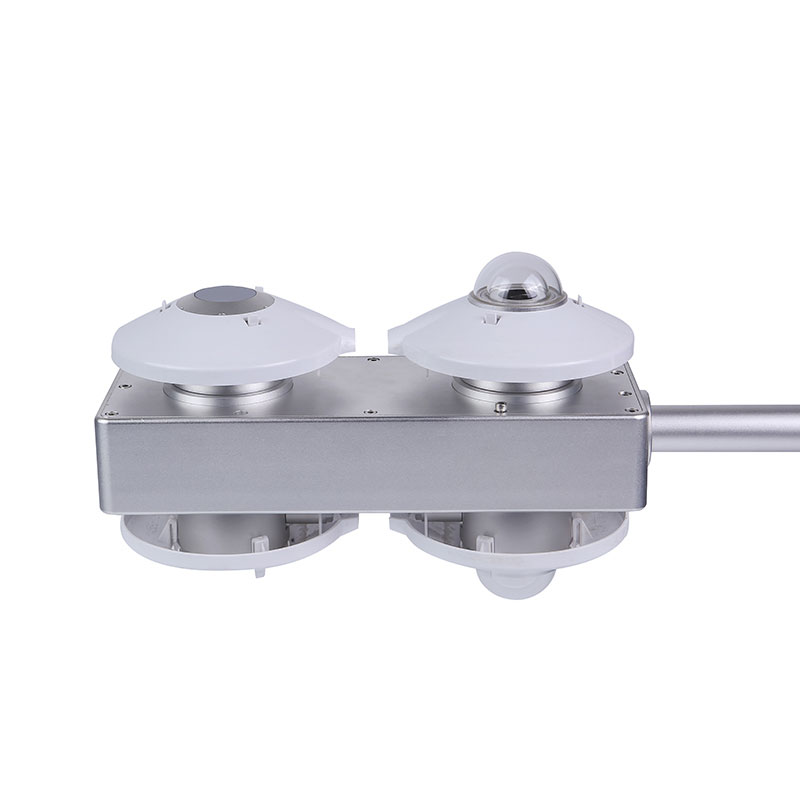
Model:FT-FS7H
Brand:tianyi
1.4-Component Net Radiometer Product Overview
4-Component Net Radiometer measures the energy balance between incoming shortwave and longwave infrared radiation and the shortwave reflected by surfaces.In meteorological applications, infrared radiation or long-wave radiation refers to electromagnetic radiation with a wavelength greater than 3.0 μm.Long-wave radiation is physically related to temperature and all objects on Earth emit long-wave radiation.The spectral range of the sun's short-wave radiation is 300nm to 3μm (accounting for 99.5% of the total solar radiation energy).
Fengtu's FT-FS7H four-component net radiation sensor directly measures the daily long-wave radiation and short-wave radiation and calculates the net radiation.Meteorological observations for atmospheric radiation (radiation emitted by clouds/water vapor and carbon dioxide, etc.) and net radiation exchange between the earth and the atmosphere.The net total radiation (short wave + long wave) is usually measured by 4 net radiation meters or a single net radiation meters (the detector can respond to the full band).The Earth's long-wave radiation meter uses a hemisphere-facing detector to measure the long-wave radiation emitted downward.Net long-wave radiation and downward emission radiation from the ground gas system can be calculated.It has been widely used in the fields of meteorology/photovoltaics/horticulture/agriculture and industry.
2.4-Component Net Radiometer product features
1.Comply with the WMO World Meteorological Organization Code (CIMO Guide)
2.Strong sensitivity to infrared radiation with wavelengths of 4 to 50 µm
3.The impact of the silicon hood has small impact on heating
4.Small cosine response error
5.Reduce environmental impact
6.Have good stability
3.4-Component Net Radiometer Technical Indicators
| Technical parameters | Technical Note |
| Total radiation | |
| Level standard | FIRST CLASS |
| Time response (95%) | 13s |
| Heat radiation zero point offset | ±10W/m2 |
| Temperature change zero point offset | ±3W/m2 |
| Nonlinear | ±1.5% |
| Instability | ±1% |
| Directive response | ±18 W/m2 |
| Spectral Error | ±3% |
| Temperature response (-10~40℃) | 3% |
| Inclination error | ±1% |
| Spectral response | 285~3000nm |
| Daily extraction accuracy | <5% |
| Resolution | 1W/m2 |
| Sensitivity | 7~14μV/W•m-2 |
| Signal output | 0~20mV |
| Earth's Radiation | |
| Spectral response | 400~50000nm |
| Response time (sec) 95% | <18s |
| Instability (change/year) | <2 % |
| Temperature coefficient | ≤±1%(-20℃~+50℃) |
| Perspective | 180° |
| Sensitivity (µV/W/m²) | 2~150uV/ Wm-2 |
| Impedance (Ω) | 20~140 |
| Window heating offset | <4W/m2 (When solar radiation is 1000W/m2) |
| Signal range | -500~+500 W/m² |
| Signal output | -20~0mV |
| General parameters | |
| Number of channels | 4-channel mV, 2-channel 4-wire platinum resistor |
| Temperature sensor | Wire type platinum resistor (JIS standard: c-1604-1989 category) |
| Operating temperature | -40~+70℃ |
| weight | 9kg |
Total Nitrogen Analyzer utilizes the resorcinol method and photoelectric quantitative technology. Its integrated design allows for rapid sampling and testing, boasts strong anti-interference capabilities, and enables real-time monitoring of total nitrogen content in water. It is widely used in...
The Wind Sensor employs the time-of-flight measurement principle, accurately calculating wind speed and direction by detecting changes in the speed of ultrasonic waves propagating in the air....
In the field of meteorological monitoring, TianYi has launched a series of Handheld Weather Stations, among which the FT-SQ5 model has attracted much attention. It integrates the monitoring functions of multiple key meteorological elements. With high-precision sensors and intelligent chips, it can a...
In the photovoltaic field, the I-V Curve Tracer is a core device used to measure and evaluate the electrical performance of solar cells and modules. The "IV" in its name stands for Current-Voltage. This instrument accurately plots the volt-ampere characteristic curve of the measured object...


 Get a Free Quote
 Skype
Skype
 whatsapp
 mail
mail