Tianyi Sensor IOT Technology Co., Ltd
Sales Manager:Ms. Emily Wang
Cel,Whatsapp,Wechat:+86 15898932201
Email:info@fengtutec.com
Add:No. 155 Optoelectronic Industry Accelerator, Gaoxin District, Weifang, Shandong, China


Sales Manager:Ms. Emily Wang
Cel,Whatsapp,Wechat:+86 15898932201
Email:info@fengtutec.com
Add:No. 155 Optoelectronic Industry Accelerator, Gaoxin District, Weifang, Shandong, China
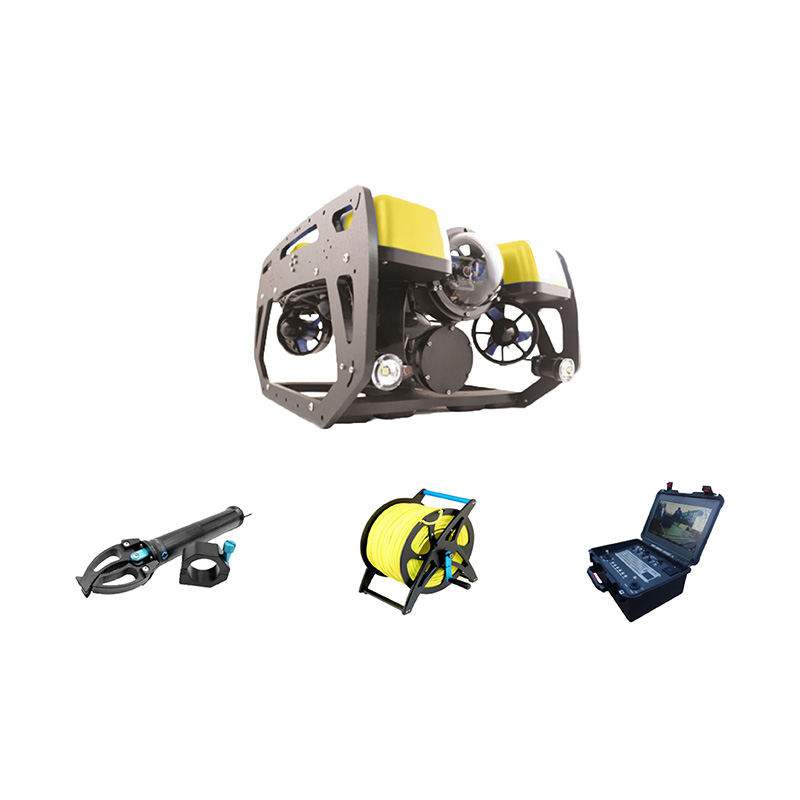
Model:FT-SXJ1
Brand:tianyi
1.Underwater Rescue Robot product introduction
Underwater Rescue Robot is a low-cost underwater search and rescue robot that improves the efficiency of water rescue and reduces the risk of rescuing people under various water currents.Underwater Rescue Robot is used for underwater search and rescue, underwater detection, and underwater observation; Underwater Rescue Robot uses high-definition camera to transmit the underwater environment back to the ground in the form of video or photos for analysis by search and rescue personnel, effectively shortening the search and rescue time and improving the search and rescue success rate; it is suitable for various waters such as seas, reservoirs, rivers, lakes, etc.
2.Underwater Rescue Robot technical parameters
1.Pressure-resistant water depth: 300m.
2.Weight: 15kg.
3.Speed: 3 knots.
4.Cable length: 300m.
5.Protection level: IP68.
6.Battery capacity: 15000mAh.
7.Battery life: 5 hours.
8.Charging time: 3 hours.
9.Thrust: 10Kg.
10.Camera gimbal: 2-megapixel HD, 1080P camera.
11.Functions: front and back and horizontal linear motion, in-situ steering, snorkeling control, underwater video, underwater photography, fixed depth motion mode, fixed navigation motion mode, free movement mode.
12.Lighting function: Equipped with LED light, brightness 5000LM, brightness adjustable.
13.Thruster: 6 thrusters (2 vertically and 4 horizontally distributed vectors).
14.Sensor configuration: acceleration, gyroscope, electronic compass, depth sensor, temperature sensor, built-in air pressure sensor of the cabin, and built-in temperature sensor of the cabin.
15.Accessories: robot, control station.
Anemometer sensors are categorized into two main types based on their operating principles: mechanical and ultrasonic. Mechanical sensors feature structures such as wind cups or propellers, while ultrasonic sensors rely on the time-of-flight method for measurement. Different models are suited...
In outdoor natural settings such as dense forests, mountain streams, vast rivers, lakes and seas, and around rushing waterfalls, people often feel the air is exceptionally fresh. The key reason behind this is that the air in these places contains a sufficient amount of negative oxygen ions. Essentia...
A hydropower station, a comprehensive engineering facility that converts hydropower energy into electrical energy, operates on the fundamental principle of utilizing water level drop (water level difference). As water flows from a higher to a lower elevation, its stored energy drives a turbine to ro...
Although traditional mechanical wind speed and direction meters have, to some extent, met basic requirements, they have limitations in terms of accuracy, response speed, and reliability. With the advancement of technology, the 3D Ultrasonic Anemometer based on the time - difference method has been d...


 Get a Free Quote
 Skype
Skype
 whatsapp
 mail
mail