Tianyi Sensor IOT Technology Co., Ltd
Sales Manager:Ms. Emily Wang
Cel,Whatsapp,Wechat:+86 15898932201
Email:info@fengtutec.com
Add:No. 155 Optoelectronic Industry Accelerator, Gaoxin District, Weifang, Shandong, China


Sales Manager:Ms. Emily Wang
Cel,Whatsapp,Wechat:+86 15898932201
Email:info@fengtutec.com
Add:No. 155 Optoelectronic Industry Accelerator, Gaoxin District, Weifang, Shandong, China
time:2025-03-04 09:42:29 source:Weather Station viewed:424 time
The measurement of wind speed and direction is of great importance in many fields, such as weather forecasting, high - speed railways, wind power generation, industrial and agricultural production, and scientific research.
In the traditional meteorological field, the measurement of wind speed and direction mainly relies on mechanical and cup - type anemometers. However, these types of anemometers have obvious drawbacks. Since they have rotating parts, during long - term operation, the components will experience wear and tear, which gradually reduces the measurement accuracy. Moreover, in harsh environments such as heavy rain, ice, and snow, their measurement accuracy will also be severely affected.
With the continuous progress of science and technology, instruments that use ultrasonic waves to measure wind speed and direction have emerged to replace traditional mechanical anemometers. Currently, the main methods for measuring wind speed and direction using ultrasonic waves include the vortex street flow method, the Doppler method, the phase - difference method, and the time - difference method. Among them, the time - difference method has shown broad application prospects in the field of wind speed and direction measurement due to its advantage of being less affected by factors such as ambient temperature and impurities.
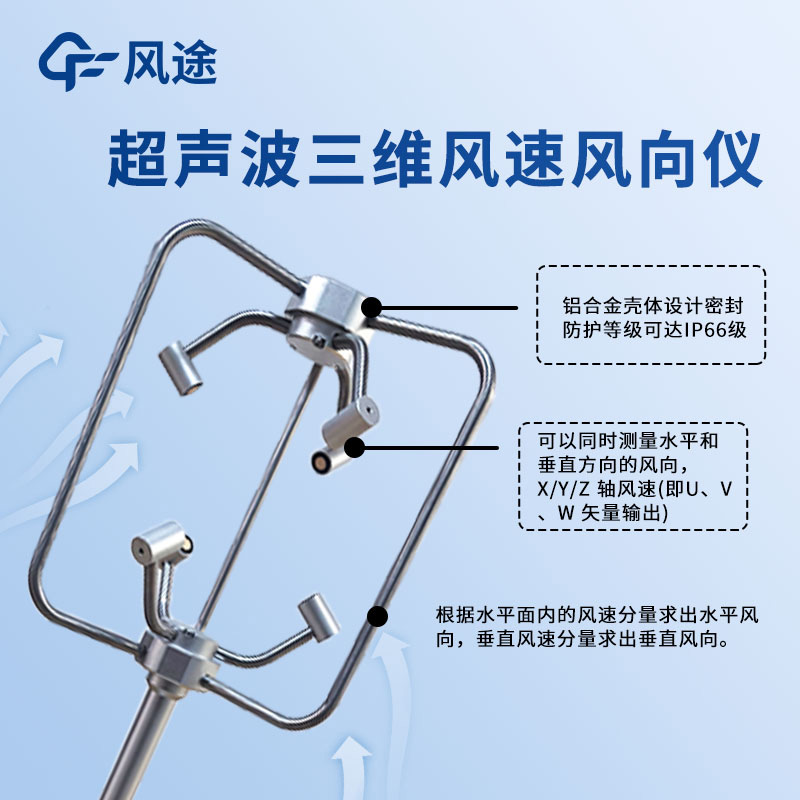
Although most ultrasonic wind speed and direction meters can measure planar wind, in specific fields such as high - speed railways and navigation, it is very necessary to obtain vertical wind information. Based on this, a 3D Ultrasonic Anemometer designed based on the time - difference method has been developed.
This 3D Ultrasonic Anemometer has unique advantages. It can not only measure planar wind but also measure vertical wind simultaneously, thus realizing the measurement of three - dimensional vector wind. This all - round measurement ability can meet the wind measurement requirements in a variety of complex environments, providing more accurate and comprehensive wind speed and direction data support for work in related fields, and is of great significance in the development process of wind speed and direction measurement technology.
Before the advent of ultrasonic anemometers, traditional wind speed and direction measurements mainly relied on mechanical sensors.Cup anemometers calculate wind speed through wind force pushing three or four hemispherical cups to rotate, with rotational speed proportional to wind speed.Wind vanes,...
The Weather Station Monitoring System is an important component of the overall environmental monitoring system. It is mainly used for real-time and continuous monitoring and data collection of various meteorological elements and related pollutants in the atmospheric environment, providing scientific...
A miniature sensor is a highly integrated meteorological monitoring device. By integrating multiple miniaturized sensors and processing units, it can realize real-time monitoring and data collection of multiple meteorological elements. The device typically integrates core components such as temperat...
In outdoor natural settings such as dense forests, mountain streams, vast rivers, lakes and seas, and around rushing waterfalls, people often feel the air is exceptionally fresh. The key reason behind this is that the air in these places contains a sufficient amount of negative oxygen ions. Essentia...


 Skype
Skype
 whatsapp
 mail
mail