Tianyi Sensor IOT Technology Co., Ltd
Sales Manager:Ms. Emily Wang
Cel,Whatsapp,Wechat:+86 15898932201
Email:info@fengtutec.com
Add:No. 155 Optoelectronic Industry Accelerator, Gaoxin District, Weifang, Shandong, China


Sales Manager:Ms. Emily Wang
Cel,Whatsapp,Wechat:+86 15898932201
Email:info@fengtutec.com
Add:No. 155 Optoelectronic Industry Accelerator, Gaoxin District, Weifang, Shandong, China
time:2025-04-22 10:01:44 source:Weather Station viewed:441 time
Wind speed and direction are important parameters in meteorological observation and environmental monitoring, and they play a significant role in many fields such as agricultural production, aerospace, and energy development. Accurate wind speed and direction data can provide strong support for disaster early warning, resource assessment, flight safety assurance, and so on.
Anemometers and wind vanes are key devices for obtaining such data. Traditional anemometers and wind vanes mainly include mechanical, ultrasonic, and thermal types. The mechanical type measures wind speed and direction through the rotation or swinging of components such as wind cups and wind vanes; the ultrasonic type calculates the wind speed based on the time difference of ultrasonic waves propagating in the air, and it has the characteristics of no moving parts and simple maintenance; the thermal type is based on the principle of heat transfer and measures the wind speed according to the cooling effect of the air flow on the heat source.
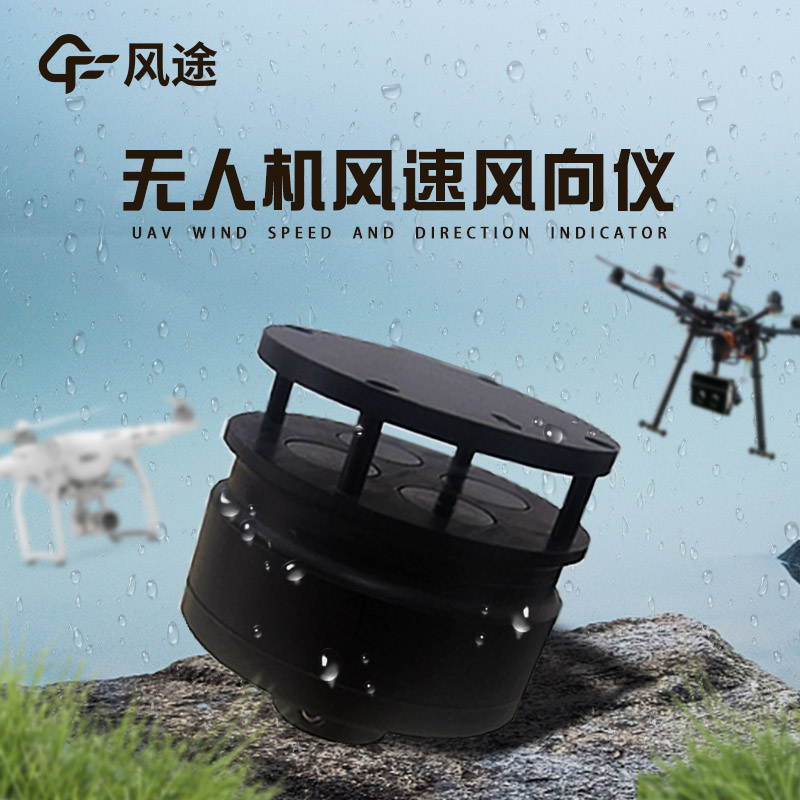
With the expansion of application scenarios, the demand for wind speed and direction monitoring in complex terrains, harsh environments, or specific high-altitude areas is increasing day by day, and the Anemometer for drones has emerged. It mounts the wind speed and direction measurement equipment on the drone platform, overcoming the limitations of traditional equipment in terms of spatial coverage and flexibility.
Take the FT-F1 model Anemometer for drones as an example. It has a compact shape and is suitable for various types of drones. This device uses ultrasonic measurement technology and can work stably within a wide temperature range from -40°C to 70°C. The measurement range of wind speed is 0-60m/s, and the measurement accuracy of wind direction can reach ±3°. The data transmission of the device is stable, and it can transmit the measured data to the ground control terminal in real time. Through the flexible flight ability of the drone, the FT-F1 can quickly reach areas that are difficult for conventional monitoring equipment to access, such as above remote mountainous areas, providing timely and accurate data support for meteorological research, disaster early warning, etc.
All in all, the Anemometer for drones has greatly expanded the scope of wind speed and direction monitoring. Against the backdrop of continuous technological development, it will play an important role in more fields and promote the precise and intelligent development of related industries.
The four key aspects of agriculture, namely soil moisture condition, crop seedling condition, pest and disease condition, and disaster condition, are crucial elements in the agricultural production process. The soil moisture condition reflects the water status of the soil, and an appropriate soil mo...
The measurement of wind speed and direction is of great importance in many fields, such as weather forecasting, high - speed railways, wind power generation, industrial and agricultural production, and scientific research.In the traditional meteorological field, the measurement of wind speed and dir...
Based on the principle of aerosol forward scattering, the instrument calculates the extinction coefficient and then derives the visibility value by measuring the intensity of infrared light scattered by atmospheric particles. It has a range of 10km, is equipped with dual power supply (battery...
The Nine - element PV Weather Station is a meteorological monitoring device specifically designed for photovoltaic power generation systems.Distributed photovoltaic power generation is mainly for self - consumption by users on the user side, and the surplus electricity is fed into the grid. The norm...


 Skype
Skype
 whatsapp
 mail
mail