Tianyi Sensor IOT Technology Co., Ltd
Sales Manager:Ms. Emily Wang
Cel,Whatsapp,Wechat:+86 15898932201
Email:info@fengtutec.com
Add:No. 155 Optoelectronic Industry Accelerator, Gaoxin District, Weifang, Shandong, China


Sales Manager:Ms. Emily Wang
Cel,Whatsapp,Wechat:+86 15898932201
Email:info@fengtutec.com
Add:No. 155 Optoelectronic Industry Accelerator, Gaoxin District, Weifang, Shandong, China
time:2025-06-05 08:51:14 source:Weather Station viewed:405 time
Throughout the long history of human interaction with the natural environment, weather has always held a pivotal position. Since ancient times, people have sought to uncover the mysteries of weather changes to better arrange their lives and production activities. In ancient times, people accumulated experience by observing natural phenomena such as clouds to predict the weather. Although these experiences had certain practicality at the time, they were greatly limited and uncertain due to factors such as regional limitations and the complexity of climate, failing to meet the growing demand for precise meteorological monitoring in modern society.
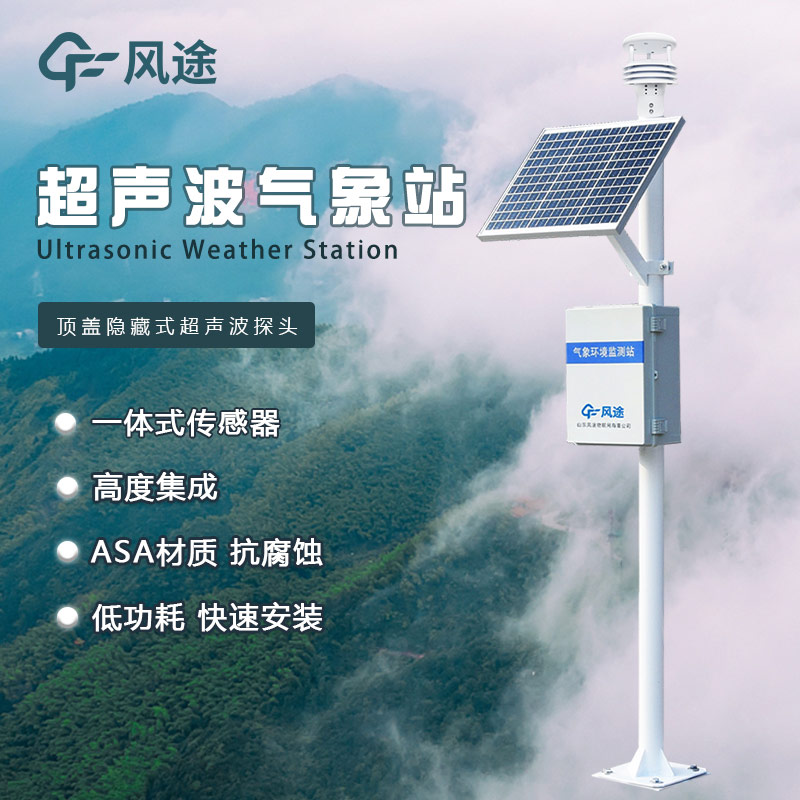
With the rapid development of technology, scientific methods have gradually replaced traditional experience as the mainstream means of weather monitoring and forecasting. The Ultrasonic Weather Station is a highly integrated and accurate automatic meteorological observation device that combines the advantages of ultrasonic anemometry technology and various sensors. It uses ultrasonic principles to accurately measure wind speed and direction, eliminating traditional mechanical components, which not only improves measurement accuracy but also breaks through angular limitations. At the same time, it can simultaneously acquire key meteorological data such as temperature, humidity, and air pressure, providing rich information for a comprehensive understanding of meteorological conditions. This is conducive to the refinement of weather forecasting, in-depth research on climate change, and the meticulous management of agricultural production.
With the help of 4G/Beidou communication technology, it can stably transmit various collected meteorological data to the IoT cloud platform, enabling efficient data processing and analysis. This allows users to obtain timely and accurate meteorological information anytime and anywhere, providing a strong basis for decision-making. At the same time, the platform's complete data storage and backup functions ensure data integrity and security, avoiding the risk of data loss.
Its integrated structural design features a simple and elegant appearance while being strong and durable. With a flange base for fixing, it can remain stable in complex and changeable field observation environments, reducing equipment shaking caused by external factors and ensuring the reliability of measurement data. The equipped solar power supply system gives it strong adaptability. Solar panels collect energy, and batteries store electrical energy, ensuring the system can operate stably for a long time even in remote areas where wiring is difficult or costly, greatly expanding its application range.
Nowadays, with the rapid development of industry, the pollution problem in industrial parks has attracted much attention. Traditional environmental monitoring methods can no longer meet the needs of refined supervision of pollution in industrial parks. However, the emergence of Air quality monitorin...
This landslide or collapse disaster monitoring equipment utilizes differential RTK technology, enabling millimeter-level displacement monitoring. Targeting geological hazards such as collapses, landslides, and debris flows, it provides long-term automated monitoring of unstable rock masses, co...
Why measure the flow velocity of a river?First, it provides data support for water resources management. By mastering the river flow velocity, water resources can be rationally allocated to ensure the water demand for daily life and production.Second, it helps with flood control and disaster reducti...
Equipped with a PVDF piezoelectric film sensing element, the piezoelectric rain gauge utilizes an embedded AI neural network to filter out dust and vibration interference. With no mechanical parts, it boasts stable performance and requires no maintenance, making it suitable for all-weather rai...


 Skype
Skype
 whatsapp
 mail
mail