Tianyi Sensor IOT Technology Co., Ltd
Sales Manager:Ms. Emily Wang
Cel,Whatsapp,Wechat:+86 15898932201
Email:info@fengtutec.com
Add:No. 155 Optoelectronic Industry Accelerator, Gaoxin District, Weifang, Shandong, China


Sales Manager:Ms. Emily Wang
Cel,Whatsapp,Wechat:+86 15898932201
Email:info@fengtutec.com
Add:No. 155 Optoelectronic Industry Accelerator, Gaoxin District, Weifang, Shandong, China
time:2025-03-27 10:00:50 source:Weather Station viewed:429 time
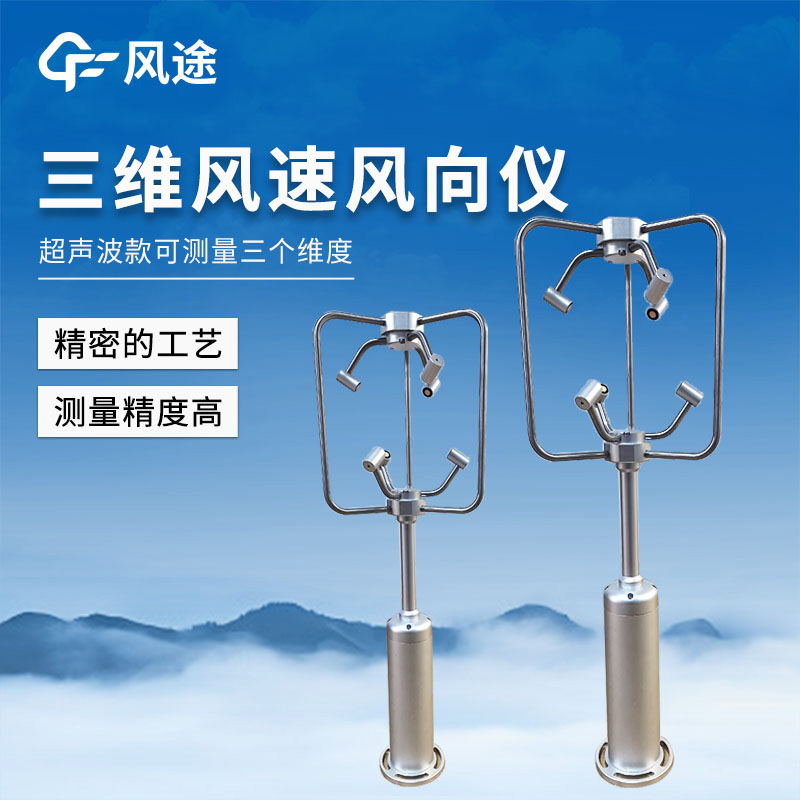
Although traditional mechanical wind speed and direction meters have, to some extent, met basic requirements, they have limitations in terms of accuracy, response speed, and reliability. With the advancement of technology, the 3D Ultrasonic Anemometer based on the time - difference method has been developed.
The core working principle of the 3D Ultrasonic Anemometer is based on the ultrasonic time - difference method. It uses ultrasonic transducers to emit ultrasonic pulses and measures the propagation time difference of these pulses along the upwind and downwind paths in the air. Since wind speed and direction affect the propagation speed of ultrasonic waves, the anemometer can accurately derive wind speed and direction by calculating the time difference.
Unlike traditional mechanical wind speed and direction meters, the 3D Ultrasonic Anemometer can measure wind speed and direction in three - dimensional space simultaneously. It is usually equipped with multiple ultrasonic sensors distributed in different directions to achieve three - dimensional measurements of horizontal wind speed, vertical wind speed, and wind direction.
Advantages:
1. The 3D Ultrasonic Anemometer features high accuracy and high resolution, enabling accurate measurement of gentle breezes and low wind speeds.
2. Lacking rotating parts, there is no mechanical wear. Thus, the measurement accuracy will not decline due to long - term use.
3. It can operate around the clock, remaining unaffected by heavy rain, snow, ice, or frost.
4. It typically adopts a stainless - steel or aluminum - alloy structure, boasting strong corrosion resistance and a long service life.
5. It is small in size, light in weight, convenient to carry, and easy to install and disassemble.
6. It supports multiple output methods such as RS485, RS232, 4 - 20mA, and GPRS, allowing for easy integration with various systems.
7. It can monitor wind speed and direction continuously in real - time without human intervention.
Precision Snow/Rain Gauge is capable of monitoring all types of precipitation—including liquid, solid, and mixed solid-liquid phases. It features a real-time precipitation intensity measurement range of 6 to 1800 mm/h and a cumulative precipitation range of 0.2 to 1500 mm, with an RS485 inter...
What are the negative oxygen ion monitors? One is a detector suitable for scenic spots, and the other is a handheld negative ion detector.For the negative ion detector in scenic spots, the FT-FZ1 Scenic Air Negative Oxygen Ion Monitor can be selected. This monitor can monitor the concentration of ne...
Present weather and visibility sensor employs the forward-scattering method to measure the total atmospheric extinction coefficient, thereby calculating visibility. It features a measurement range of 2 km and a resolution of 1 m, with measurement errors controlled in segments based on distance...
Leveraging the propagation characteristics of sound waves underwater, Water Rescue Equipment performs underwater detection through electro-acoustic conversion and signal processing. It provides scanned views, 3D visualizations, and underwater life detection capabilities for riverbeds and water...


 Skype
Skype
 whatsapp
 mail
mail