Tianyi Sensor IOT Technology Co., Ltd
Sales Manager:Ms. Emily Wang
Cel,Whatsapp,Wechat:+86 15898932201
Email:info@fengtutec.com
Add:No. 155 Optoelectronic Industry Accelerator, Gaoxin District, Weifang, Shandong, China


Sales Manager:Ms. Emily Wang
Cel,Whatsapp,Wechat:+86 15898932201
Email:info@fengtutec.com
Add:No. 155 Optoelectronic Industry Accelerator, Gaoxin District, Weifang, Shandong, China
time:2025-08-19 08:48:00 source:Weather Station viewed:470 time
Dust pollution refers to an open-air pollution phenomenon where ground dust is blown into the atmosphere by wind, human activities, or other factors. In ambient air, it is a component of total suspended particles (TSP) and poses a severe threat to atmospheric environmental quality. There are various sources of dust pollution:
Road dust: Mainly comes from tire-ground friction during vehicle movement, dust carried by exhaust gases, and dust stirred up by vehicles driving on unpaved roads.
Construction dust: Generated from material handling, earthwork operations, and other activities at construction sites.
Soil dust: Mostly lifted by wind due to exposed ground surfaces and loose soil.
Stockyard dust: Caused by wind and other factors at material storage sites, leading to dust emission.
Dust pollution is highly hazardous. Fine particles such as PM2.5 in dust are easily inhaled by the human body, irritating the respiratory mucosa and causing diseases like cough, asthma, and bronchitis. Especially for the elderly, children, and people with weak immunity, long-term exposure will increase the risk of lung infections, cardiovascular diseases, and other illnesses. Moreover, dust covering plant leaves hinders photosynthesis and respiration, affecting plant growth; some pollutants enter soil and water bodies with precipitation, damaging soil fertility and polluting water quality. Dust also reduces air quality, causes hazy weather, impairs visibility, and disrupts daily travel; the resulting visual pollution also damages the aesthetic appearance of cities.
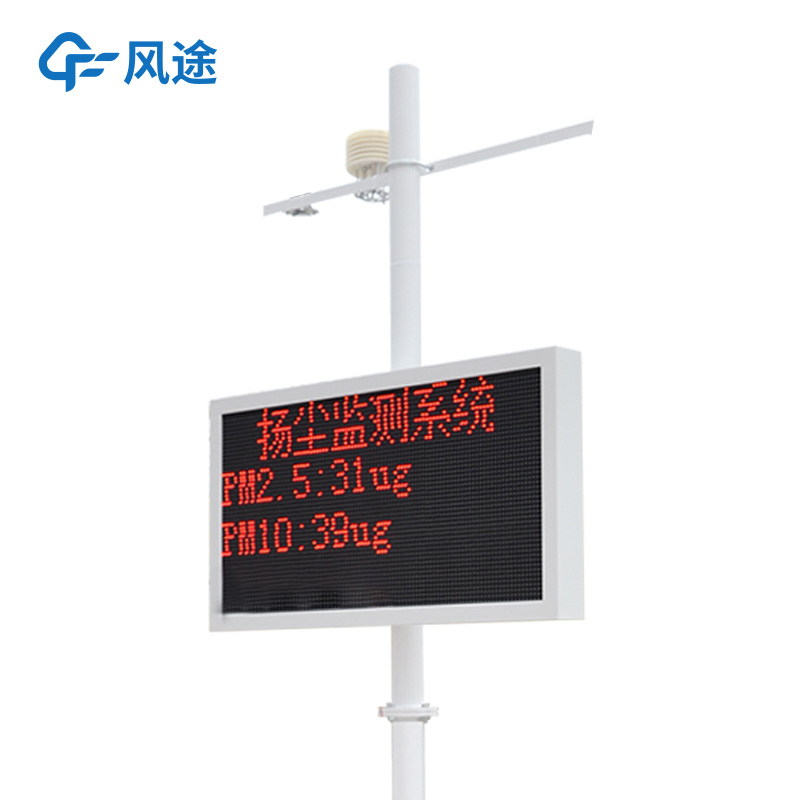
To effectively control dust pollution, our company has carefully launched the Online Dust Monitoring System (integrated with noise detection function). The device features multiple monitoring functions: it is equipped with a high-precision sampling pump that actively draws air samples, enabling simultaneous monitoring of PM2.5, PM10, TSP (Total Suspended Particles), noise, temperature, humidity, wind speed, wind direction, and air pressure.
Monitoring data is transmitted to the monitoring terminal in real time, with an intuitive and clear interface that allows staff at the monitoring center to view and analyze the data at any time. Equipped with an intelligent linkage function, when the monitored dust concentration exceeds the preset threshold, it will automatically trigger the fog cannon equipment to start dust suppression operations, eliminating the need for manual operation. This greatly improves dust suppression efficiency and reduces labor costs.
The system can also connect to the government environmental monitoring platform with a simple process:
The customer first provides the connection agreement of the government platform.
Our professional technicians conduct an in-depth analysis of the agreement to confirm compatibility and connection feasibility, including detailed verification of interface specifications, data transmission formats, security requirements, and other aspects.
After confirming the feasibility of connection, we complete the connection work for the customer, realizing data intercommunication between the device and the government platform and helping the government carry out environmental supervision work efficiently.
The core of the Odor Online Monitor lies in simulating human olfactory perception, enabling simultaneous monitoring of multiple malodorous pollutants. It is particularly suitable for 24/7 continuous monitoring in environments such as landfill sites, chemical industrial parks, and wastewater treatmen...
3D Ultrasonic Anemometer can measure the horizontal and vertical wind speed and direction values in three-dimensional space at high frequency, providing accurate and real-time data support for various industries.The working principle of this sensor is based on the propagation characteristics of ultr...
As a key device in modern meteorological monitoring, one of the primary advantages of the wireless Small Automatic Weather Station is its adoption of wireless data transmission technology.1. Freedom from Wired Infrastructure LimitationsTraditional wired weather stations are constrained by cabling, b...
Under the general trend of technology empowering agriculture, Agricultural meteorological stations are gradually becoming key facilities for ensuring agricultural production and promoting the modernization of agriculture.It can conduct real-time and precise monitoring of various meteorological...


 Skype
Skype
 whatsapp
 mail
mail