Tianyi Sensor IOT Technology Co., Ltd
Sales Manager:Ms. Emily Wang
Cel,Whatsapp,Wechat:+86 15898932201
Email:info@fengtutec.com
Add:No. 155 Optoelectronic Industry Accelerator, Gaoxin District, Weifang, Shandong, China


Sales Manager:Ms. Emily Wang
Cel,Whatsapp,Wechat:+86 15898932201
Email:info@fengtutec.com
Add:No. 155 Optoelectronic Industry Accelerator, Gaoxin District, Weifang, Shandong, China
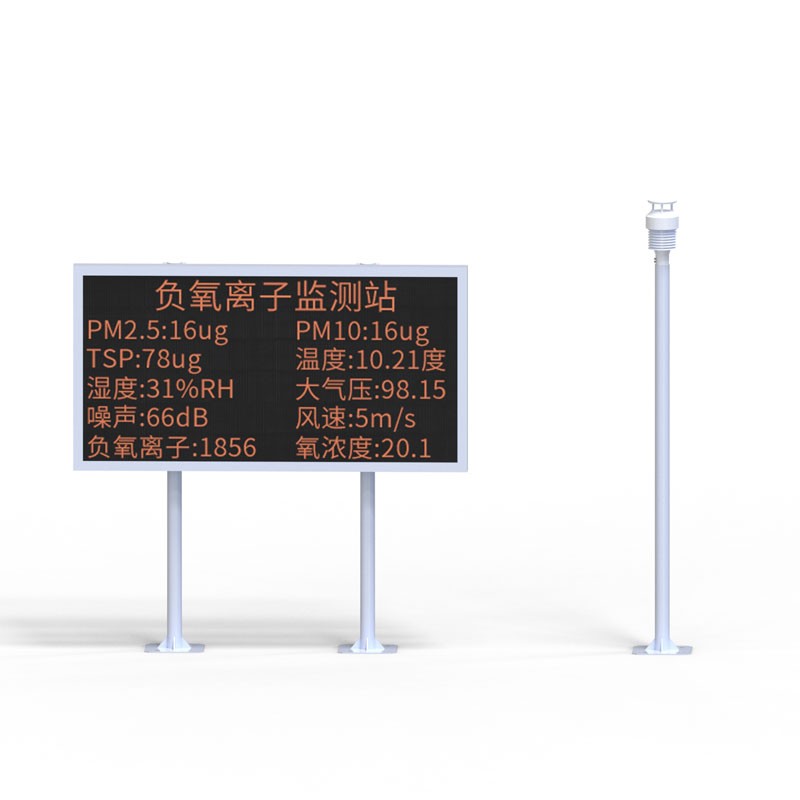
Model:FT-FZ3
Brand:tianyi
1、Negative oxygen ion monitoring station Product Overview
negative oxygen ion monitoring station can monitor negative oxygen ions and other air quality factors around the clock, fully automatically and unattended.The Negative oxygen ion monitoring station provides round-the-clock monitoring of atmospheric negative oxygen ion concentrations. It also supports the expansion of monitoring parameters based on user requirements—such as air temperature, humidity, PM2.5, PM10, atmospheric pressure, oxygen levels, noise, wind speed, and wind direction. Featuring a modular design, the unit allows for the individual replacement of sensors and comes with a professional mounting bracket. Data can be read directly on-site via an LED display or viewed in real-time through a remote cloud platform, web interface, or WeChat official account, ensuring convenient long-term operation and maintenance.
2、Negative oxygen ion monitoring station Applications
Tourist attractions, eco-estates, wetland parks, waterfall parks, forest parks, nature reserves, sales centers, and schools.
3、Negative oxygen ion monitoring station Technical Specifications
1. Wind speed: Ultrasonic measurement principle; 0–60 m/s (±0.1 m/s); resolution 0.01 m/s;
2. Wind direction: Ultrasonic measurement principle; 0–360° (±2°); resolution 1°;
3. Air temperature: Diode junction voltage measurement principle; -40–60°C (±0.3°C); resolution 0.01°C;
4. Air humidity: Capacitive measurement principle; 0–100% RH (±0.3% RH); resolution 0.1% RH;
5. Atmospheric pressure: Piezoresistive measurement principle; 300–1100 hPa (±0.25%); resolution 0.1 hPa;
6. PM2.5: Light scattering measurement principle; 0–1000 µg/m³ (±10%); resolution 1 µg/m³;
7. PM10: Light scattering measurement principle; 0–1000 µg/m³ (±10%); resolution 1 µg/m³;
8. Noise: Capacitive measurement principle; 30–120 dB (±1.5 dB); resolution 0.1 dB;
9. Negative oxygen ions 9. Ion concentration: Measurement principle—cylindrical aspiration electrode; range: 0–100,000 ions/cm³ (±10%); resolution: 1 ion/cm³
10. Oxygen content: Measurement principle—electrochemical; range: 0–25% Vol (±3% FS); resolution: 0.1%
11. Data storage: Capable of storing one year of raw monitoring data
12. Data transmission: 4G/Fiber optic
13. Power consumption: 800W
14. Power supply: 220V mains power, solar power (optional)
15. Operating environment: Temperature -40°C to 60°C; humidity 0% to 100%
16. Screen: 2m × 1m, assembled from 36 P10 single-red LED modules (module dimensions: 32cm × 16cm)
17. Support structure: Carbon steel dual-column design; each column is formed by connecting two 1.5m sections via flanges; capable of withstanding Category 15 typhoons
18. Manufacturer holds ISO certifications for Quality Management, Environmental Management, and Occupational Health and Safety Management systems
19. Manufacturer holds a computer software registration certificate
20. Manufacturer is a 3A-rated credit enterprise
4、Negative oxygen ion monitoring station Product Features
1. High integration and flexible configuration: The system can integrate monitoring for negative oxygen ions, air temperature, humidity, PM2.5, PM10, atmospheric pressure, oxygen levels, noise, wind speed, and wind direction.
2. System stability: Proven track record with thousands of parks and scenic areas; the backend operates reliably with low maintenance requirements and a low failure rate.
3. Multiple transmission options: Transmission methods—such as 2G, 4G, or fiber optics—can be customized based on on-site network conditions.
4. Expandability: Supports sensor expansion; sensors utilizing RS-485 interfaces and Modbus protocols can be connected directly.
5. Diverse display solutions: LED screen data display configurations—including point-to-point, point-to-multipoint, and multipoint-to-point setups—can be selected to meet specific on-site requirements.
5、Negative oxygen ion monitoring station Cloud Platform Overview
1. Client-Server (C/S) architecture platform; supports direct monitoring via mobile and PC browsers—no additional software installation required.
2. Supports multi-account and multi-device logins.
3. Features dashboards for displaying real-time and historical data.
4. Utilizes cloud servers and cloud data storage; offers stability, reliability, scalability, and load balancing.
5. Supports SMS alerts and threshold configuration.
6. Supports map-based visualization and device information viewing.
7. Supports data trend analysis (graphing).
8. Supports data export to spreadsheet formats.
9. Supports data forwarding (including HJ-212 protocol, TCP forwarding, HTTP protocol, etc.).
10. Supports data post-processing functions.
11. Supports the execution of external JavaScript scripts.
As a densely - populated public place, the air quality in scenic spots directly affects the tourist experience and ecological value. The negative oxygen ion concentration, as a core indicator for measuring air quality, has made its monitoring system a standard configuration in the construction of sm...
With the vigorous development of smart agriculture, the four aspects of agricultural condition monitoring have become a key driver in advancing the modernization of agriculture. So, what exactly are these four aspects of agricultural condition monitoring in smart agriculture? In fact, they include s...
Debris flow is a common sudden geological disaster in mountainous areas. Triggered by heavy rains and melting snow and ice, it carries a large amount of solid materials such as sediment and rocks, flowing rapidly with strong impact force and a wide range of destruction. It often causes severe damage...
Agriculture, as the foundation of human survival, is intricately linked to the weather. Weather conditions profoundly influence every aspect of agricultural production. During the sowing stage, seed germination requires suitable accumulated temperature, typically above 10°C. If the temp...


 Get a Free Quote
 Skype
 whatsapp
 mail