Tianyi Sensor IOT Technology Co., Ltd
Sales Manager:Ms. Emily Wang
Cel,Whatsapp,Wechat:+86 15898932201
Email:info@fengtutec.com
Add:No. 155 Optoelectronic Industry Accelerator, Gaoxin District, Weifang, Shandong, China


Sales Manager:Ms. Emily Wang
Cel,Whatsapp,Wechat:+86 15898932201
Email:info@fengtutec.com
Add:No. 155 Optoelectronic Industry Accelerator, Gaoxin District, Weifang, Shandong, China
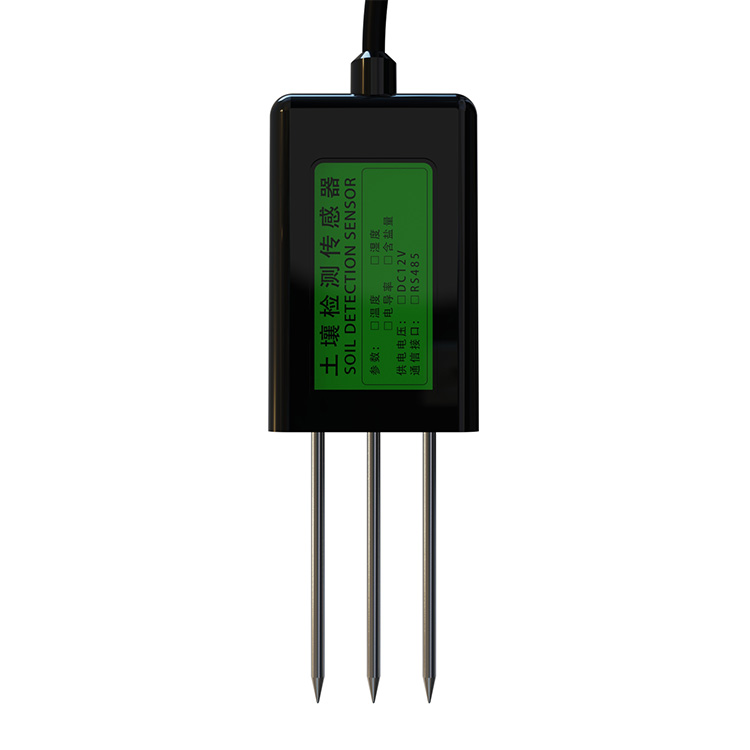
Model:WSY485
Brand:tianyi
1.Soil Temperature Moisture Salt Sensor Technical Indicators
Soil Temperature Moisture Salt Sensor measures soil moisture, temperature and electrical conductivity (EC) with high accuracy, fast response and stable output.
1.Power supply: DC12V
2.Power consumption: less than 0.1W
3.Working temperature: -30~70℃
4.Communication interface: RS485
5.Operating current: 8mA DC12V
6.Minimum data interval: 60S
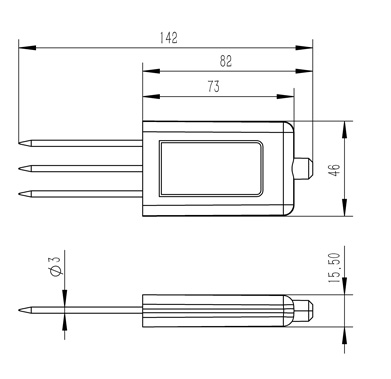
2.Soil Temperature Moisture Salt Sensor Product Size Diagram
3.Precautions for using Soil Temperature Moisture Salt Sensor
1.The sensor installation should be carried out strictly in accordance with the installation instructions.
2.When multiple sensors work at the same time, they must be spaced more than 5 meters apart.
3.The sensor measurement principle is limited.The sensor measurement site is a central radius of 5 meters.There should be no electromagnetic cables and strong magnetic radiation interference.
Avoid huge errors and damage caused by sensor measurements.
4.The installation environment of the sensor should comply with the measurement range of the sensor to avoid irregular behaviors such as exceeding the range.
5.The sensor installation should be avoided in the environment of strong acids, strong alkalis, heavy oil and polluted heavy metals.
6.The sensor is a soil measurement sensor, and it is prohibited to use this sensor for other behaviors.
7.The sensor installation environment cannot have strong vibration.
8.The sensor cannot have too strong external force.
9.Disassembly is prohibited, and disassembly will not provide any services.
10.The sensor probe is relatively sharp, so you should wear protective gear according to regulations when using it.
11.The use and maintenance of equipment should be carried out strictly in accordance with the above precautions.If there is any illegal use, the company will not bear the relevant responsibility.
4.Soil Temperature Moisture Salt Sensor parameters
| parameter | Measurement range | Accuracy | Resolution | unit |
| Soil temperature | -30~70℃ | ±0.3 (-10~50℃) | 0.01 | ℃ |
| Soil moisture content | 0~100% | ±3% (loam) High organic matter soil (soil organic carbon content >12%) High colloid content soil (colloid content >45%) Due to its dielectric relaxation properties, calibration may be required for specific soil types. | 0.01% | --- |
| Soil conductivity | 0~20000 | ±3% (15℃, 0~10000us/cm) ±5% (full range) | 1 | us/cm |
| Soil salt content | 0~12800 | ±3% | 1 | mg/L |
This landslide or collapse disaster monitoring equipment utilizes differential RTK technology, enabling millimeter-level displacement monitoring. Targeting geological hazards such as collapses, landslides, and debris flows, it provides long-term automated monitoring of unstable rock masses, co...
Stainless Steel Tipping Bucket Rain Gauge employs a standard Φ200mm diameter aperture and a bistable tipping bucket structure. Each bucket triggers tipping when it receives 0.2mm of rainfall. It supports Modbus 485 signal output and ±2% measurement error, making it suitable for monitoring li...
Air quality monitoring stations for road traffic primarily aim to conduct real - time monitoring of air quality in traffic - intensive areas. They integrate data from environmental monitoring networks, meteorological parameters, and vehicle - related information. By doing so, these stations analyze...
Weather Phenomenon Sensor employs the forward-scatter method to measure the total atmospheric extinction coefficient, thereby calculating current visibility. It is capable of identifying various weather phenomena—including fog, rain, snow, mixed precipitation, and clear conditions—and provid...


 Get a Free Quote
 Skype
Skype
 whatsapp
 mail
mail