Tianyi Sensor IOT Technology Co., Ltd
Sales Manager:Ms. Emily Wang
Cel,Whatsapp,Wechat:+86 15898932201
Email:info@fengtutec.com
Add:No. 155 Optoelectronic Industry Accelerator, Gaoxin District, Weifang, Shandong, China


Sales Manager:Ms. Emily Wang
Cel,Whatsapp,Wechat:+86 15898932201
Email:info@fengtutec.com
Add:No. 155 Optoelectronic Industry Accelerator, Gaoxin District, Weifang, Shandong, China
time:2025-08-28 08:56:06 source:Weather Station viewed:368 time
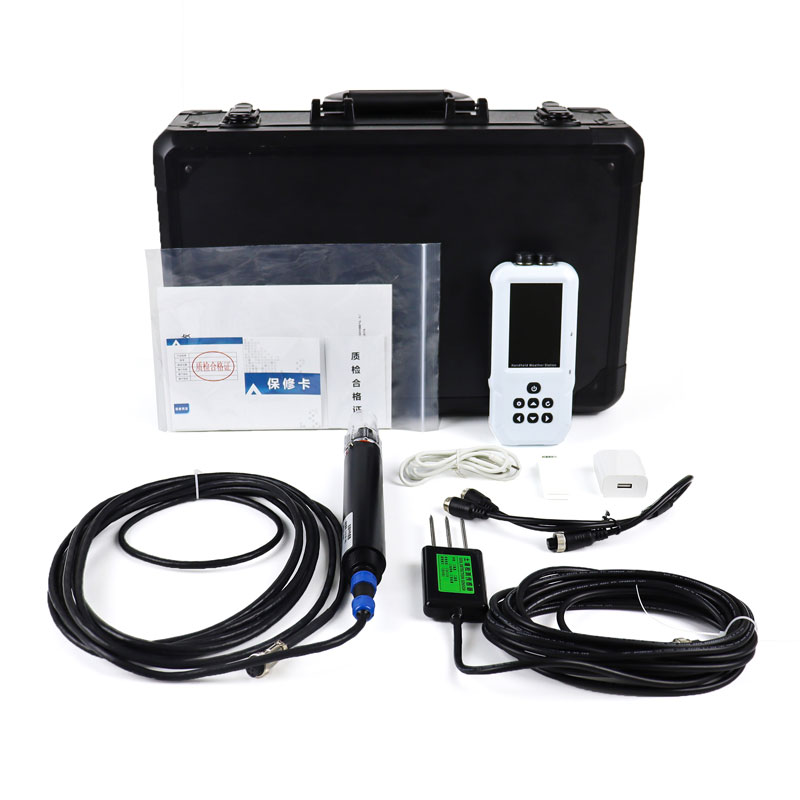
In meteorological observation work, the Portable Weather Station has become a commonly used device among practitioners, relying on its three core features: "portability, reliability, and accuracy". Its performance and practicality are widely recognized, enabling it to meet the monitoring needs of multiple scenarios.
It can simultaneously monitor a variety of meteorological parameters, with core functions integrated in a compact structure. It boasts high reliability, low power consumption, and long battery life. Featuring a small size and light weight, it is convenient for transportation and on-site deployment; the installation steps are simple, and the supporting bracket is foldable and telescopic, taking up little space for storage. During use, it is compatible with multiple communication methods and can be activated without complex debugging. It has a built-in rechargeable power module, which can adapt to the power needs of different scenarios.
In terms of design, it balances integration and portability. Normally, it can real-time monitor five commonly used meteorological elements: wind speed, wind direction, temperature, humidity, and air pressure. For scientific research or special monitoring needs, additional sensors can be customized and installed. The bracket is made of high-strength aluminum alloy, and the sensor housing is made of weather-resistant engineering plastic, ensuring a stable and impact-resistant structure, wear resistance, and corrosion resistance, thus extending the service life of the device.
It supports flexible power supply methods, including solar energy, lithium battery, and 12V DC power supply converted from municipal electricity. In continuous rainy weather, the energy storage of the lithium battery can ensure the operation of the device, preventing interruptions in data collection.
Its data management system is comprehensive. It is equipped with a fully waterproof data acquisition host, with a built-in large-capacity storage unit for storing historical data. When connected to a computer, data can be queried and exported; real-time data can be intuitively viewed through an LCD screen or touch screen. It is also compatible with communication interfaces such as RS485, facilitating linkage with other devices or platforms.
It has a wide range of applications, including meteorological observation, agriculture and forestry environmental protection, marine monitoring, airport and port support, scientific expeditions, and campus teaching. It can meet the needs of emergency temporary observation, long-term small-scale monitoring, and mobile monitoring, providing accurate data support.

In numerous meteorological monitoring and related fields, accurately measuring wind speed and direction is of great significance. From the perspective of large-scale meteorological research, understanding accurate data of wind speed and direction helps meteorological departments better predict weath...
Meteorological stations are equipped with a variety of instruments to measure meteorological elements such as temperature, humidity, wind speed, wind direction, atmospheric pressure, and precipitation. Key instruments include platinum resistance temperature sensors, capacitive humidity sensors...
A meteorological observation station is a facility used to monitor and record meteorological information. It collects data on weather conditions through various instruments and equipment, providing important basis for weather forecasting, climate research and disaster warning.As a professional facil...
In the photovoltaic industry, requirements for module quality and reliability are becoming increasingly stringent. Traditional inspection methods cannot effectively identify internal defects, making EL (Electroluminescence) defect detection technology an indispensable quality control tool in photovo...


 Skype
 whatsapp
 mail