Tianyi Sensor IOT Technology Co., Ltd
Sales Manager:Ms. Emily Wang
Cel,Whatsapp,Wechat:+86 15898932201
Email:info@fengtutec.com
Add:No. 155 Optoelectronic Industry Accelerator, Gaoxin District, Weifang, Shandong, China


Sales Manager:Ms. Emily Wang
Cel,Whatsapp,Wechat:+86 15898932201
Email:info@fengtutec.com
Add:No. 155 Optoelectronic Industry Accelerator, Gaoxin District, Weifang, Shandong, China
time:2026-02-12 10:53:36 source:Weather Station viewed:332 time
instrument used to measure rainfall rain gauge employs a pure infrared light source and a narrow-band filter, with a sensing area of 78 square centimeters. It measures rainfall with high precision through the principle of optical scattering. The device is unaffected by high-intensity sunlight, has a fast response speed, and a long maintenance-free period. It is suitable for automatic rainfall monitoring in meteorological, hydrological, agricultural, and harsh field environments, providing continuous and stable precipitation data.
Precipitation measurement is a fundamental parameter for weather forecasting, hydrological scheduling, and agricultural irrigation. Traditional tipping bucket rain gauges rely on mechanical tipping and magnetic reed switches, which suffer from wear, sediment deposition, and evaporation losses over long-term use, requiring regular on-site cleaning and leveling. While weighing rain gauges can measure solid precipitation, they consume a lot of power and require manual emptying of the storage tank. The instrument used to measure rainfall rain gauge utilizes the scattering effect of infrared light on the surface of raindrops to achieve non-contact rainfall intensity measurement. It has no moving parts or storage containers, significantly reducing the frequency of maintenance at field stations.
The sensor's optical system consists of a pure sinusoidal infrared light source and a narrow-band filter. A constant-current driven light source emits a stable wavelength infrared beam to the rain-sensing area. When raindrops pass through the rain-sensing surface, the beam is scattered. A photodetector receives the change in the intensity of the scattered light, which is then converted into instantaneous rainfall intensity and cumulative rainfall through analog-to-digital conversion and an algorithm model. A built-in narrowband filter allows only specific wavelengths of infrared light to pass through, effectively filtering out stray radiation of the same wavelength from sunlight. In clear weather, the output zero-value drift is less than 0.01 mm/hour. The rain-sensing surface has a design area of 78 square centimeters, larger than the conventional instrument used to measure rainfall sampling aperture, improving the capture rate of raindrops smaller than 0.2 mm in diameter by more than 30%, reducing missed detection errors.
The device's total power consumption is less than 20 milliwatts, supporting long-term float charging power from solar panels and lithium batteries, allowing for continuous operation for more than three years without mains power. The casing is made of UV-resistant ASA engineering plastic, with an IP66 waterproof and dustproof rating, and an operating temperature range of -40°C to 70°C. The rain-sensing surface is coated with a hydrophobic film layer, allowing raindrops to slide off quickly and preventing water film retention that could cause continuous false triggering. The sensor has no adjustable parts; during installation, only the sensing surface needs to be kept horizontal, eliminating the need for on-site calibration and manual zeroing.
In the regional automatic weather station network, instrument used to measure rainfall outputs rainfall intensity and minute precipitation on a minute-by-minute basis. The data is integrated into a meteorological big data platform, providing high temporal resolution rainfall data for short-term nowcasting and supporting the issuance of orange and red rainstorm warnings. Hydrological monitoring stations are deployed at the upper reaches of small and medium-sized rivers and small watershed control sections. Real-time rainfall is transmitted to flood forecasting models, and runoff parameters are rolled over every five minutes based on rainfall intensity, extending the lead time. Agricultural soil moisture stations calculate crop evapotranspiration based on effective rainfall, automatically generating irrigation recommendations to avoid ineffective irrigation on non-rainy days.
In urban flood monitoring scenarios, sensors are installed in low-lying sections of underpasses and on the side walls of tunnel entrances. When rainfall intensity exceeds the drainage system's design standards, the platform sends a pre-pumping command to the municipal drainage pumping station and activates LED warning screens to restrict vehicle access. The highway traffic meteorological station integrates instrument used to measure rainfall, enabling it to determine the onset of rainfall with an advance margin of less than ten seconds, automatically switching variable speed limit signs, and reducing the risk of accidents on slippery road sections. Airport meteorological observations incorporate optical rain gauges as encrypted backups for tipping bucket rain gauges, eliminating mechanical inertial errors and meeting the precise requirements of aircraft takeoffs and landings for instantaneous rainfall intensity.
Long-term operational stability has been tested in various climate zones across China, with deviations from the annual cumulative values of standard rain gauges within 5%, and no zero-point drift cumulative errors. The sensor outputs via RS485 Modbus protocol or pulse counting, compatible with existing data loggers and IoT wireless terminals. With the shrinking of manual observation network and the widespread adoption of unmanned operation and maintenance, instrument used to measure rainfall is transforming from an auxiliary supplementary device into a core rainfall monitoring tool, supporting the evolution of rainfall observation towards higher frequency, lower maintenance, and grid-based methods.
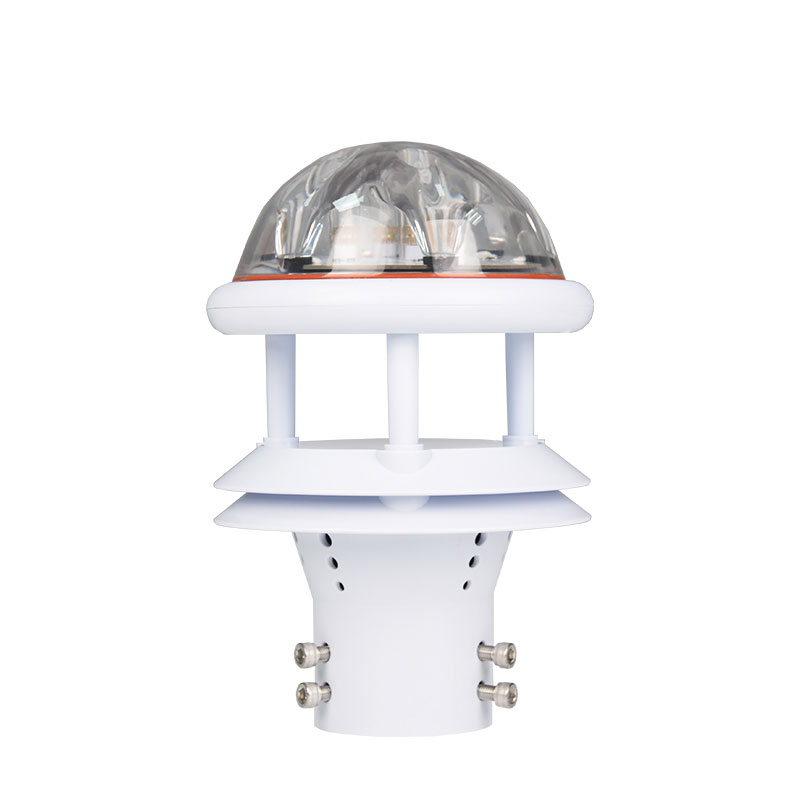
Although traditional mechanical wind speed and direction meters have, to some extent, met basic requirements, they have limitations in terms of accuracy, response speed, and reliability. With the advancement of technology, the 3D Ultrasonic Anemometer based on the time - difference method has been d...
With the advancement of environmental science research toward refinement, traditional large-scale air monitoring stations suffer from low distribution density and limited coverage, making it difficult to capture air quality differences in small-scale areas such as urban functional zones and around p...
Underwater search and rescue robot is a high-performance underwater detection device integrating sonar scanning and high-definition video imaging. It uses sonar for large-area scanning and positioning, combined with high-definition video for detailed observation, providing scanned and 3D views of riverbeds and water bodies. It accurately identifies the outlines and locations of underwater targets and is widely used in underwater surveying and exploration....
This fully automated online hydrological monitoring device, based on K-band planar radar technology, can simultaneously measure water level, flow velocity, flow rate, and rainfall. Employing a non-contact measurement method, it is unaffected by silt and sewage corrosion. Its built-in intellige...


 Skype
Skype
 whatsapp
 mail
mail