Tianyi Sensor IOT Technology Co., Ltd
Sales Manager:Ms. Emily Wang
Cel,Whatsapp,Wechat:+86 15898932201
Email:info@fengtutec.com
Add:No. 155 Optoelectronic Industry Accelerator, Gaoxin District, Weifang, Shandong, China


Sales Manager:Ms. Emily Wang
Cel,Whatsapp,Wechat:+86 15898932201
Email:info@fengtutec.com
Add:No. 155 Optoelectronic Industry Accelerator, Gaoxin District, Weifang, Shandong, China
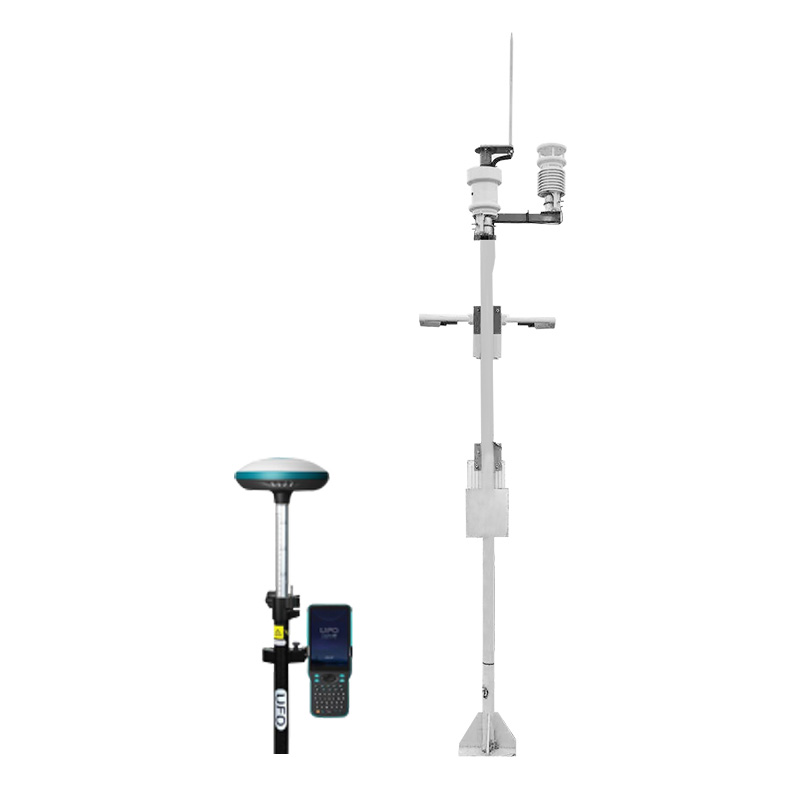
Model:FT-HQ1
Brand:tianyi
Ship weather station
Ship weather station is a multifunctional measuring tool that can accurately measure real-time wind speed, wind direction and other marine weather parameters.Main use locations: ship, drilling platform, island, port
1.Ship weather station product overview
Ship weather station mainly uses integrated acquisition and control technology, computer software technology, communication technology and other technologies to integrate the application of a variety of meteorological sensors from structure to system composition.It can continuously obtain marine meteorological information, can conduct real-time detection of visibility, ultrasonic wind speed, ultrasonic wind direction, air temperature, air humidity, atmospheric pressure, optical rainfall, light intensity, etc., and summarize various data through remote transmission and promptly transmit it to the transportation department, providing first-hand information for the relevant marine departments to provide meteorological guarantee services.Based on this, it can provide timely meteorological information services for the travel of marine safety authorities and people.
The meteorological sensors used by Ship weather station include: visibility weather phenomenon detector, rheumatism, temperature, pressure, rain and light integrated micro meteorological station, Beidou high-precision positioner, etc., and also include dedicated integrated meteorological data collector, support structure, power supply communication control box and other units.
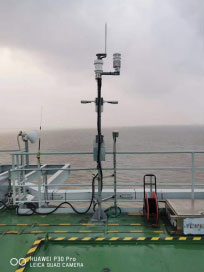
Real photos
2.Ship weather station function
(1) Be able to conduct real-time detection of visibility, ultrasonic wind speed, ultrasonic wind direction, air temperature, air humidity, atmospheric pressure, optical rainfall, light intensity, Beidou positioning, etc.
(2) Actively collect data from each meteorological element, pre-process and algorithmically process the collected data, conduct relevant statistics on the collected data to form a minute-by-minute value and position it and store it in the monitoring station memory;
(3) Automatically upload monitoring data, with the upload frequency of 1 minute;
(4) The meteorological monitoring station provides communication methods such as RS232, RS485, RJ45 network ports, GPRS wireless;
(5) System power supply method: 220V AC mains or 12VDC solar power supply.
3.Ship weather station instrument features
lThe monitoring station adopts a modular assembly structure design, which is compact and compact, with small size, light weight, and easy to install;
l The system power consumption is low, less than 10W, and can be powered by mains or solar power;
l The system has lightning protection measures, and its communication interface and power interface are both lightning-proof designs, which can minimize lightning damage.
4.Ship weather station main sensors and unit composition
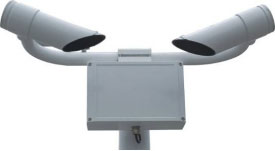
a) Visibility weather phenomenon detector
b) Small ultrasonic automatic weather station

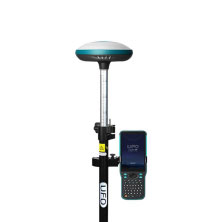
c) Beidou positioning detector
5.Typical technical indicators of Ship weather station
Measurement elements | Measurement range | Resolution | Accuracy |
visibility Weather phenomena | 5m ~ 10km | 1m | ≤2km, error ±2% 2Km—10km, error ±5% Weather phenomenon measurement types: fog (light fog, fog, thick fog), rain (light rain, moderate rain, heavy rain), snow (light snow, moderate snow), mixed precipitation (sleet), etc. |
Air temperature | -40~+80℃ | 0.1℃ | ±0.2℃ |
Relative humidity | 0~100% | 0.1% | ±2% |
wind direction | 0~360° | 1° | ±3° |
Wind speed | 0 ~ 75m/s | 0.01m/s | ±2% |
Precipitation (mm) | 0-10mm/min | 0.01mm | ±0.4mm (cumulative rainfall <10mm); |
Air pressure | 150 ~ 1200hPa | 0.1hPa | ±1 hPa |
Light intensity | 0-200000LMUX | 0.1LUX | 0.054LUX |
Comprehensive meteorological data collector | modbus485 interface: GX-12-4P aerospace plug, output power supply voltage 12V Equipment configuration interface: GX-12-4P aerospace plug, input voltage 5V. Collector power supply interface: GX-12-3P aerospace plug, input voltage 5V, with RS232 output. Capacitor power supply: DC5V ±0.5V peak current 1A. Working ambient temperature: -10~+45℃.Working environment: -20-80℃, humidity ≤100% without condensation. Communication method: supports modbus485, supports GPRS communication, supports RS232 data output, supports Lora wireless communication, and data upload interval: 30s-65535s adjustable. Operating current: 20mA, sleep current: <50uA. Extended sensor protocol: modbus485, maximum number of extended sensors: 32, Extended sensor voltage: 12V Extended sensor current: ≤2A Built-in sensor: temperature, humidity, atmospheric pressure | ||
Overall power supply method | 220V AC mains or 12VDC "solar + battery" power supply | ||
Overall power consumption | All sensors in the system are designed with low power consumption, with power consumption less than 10W | ||
Meteorological monitoring equipment includes six-parameter automatic weather stations, precipitation sensors, radiation observation stations, and unmanned aerial vehicle (UAV) systems, used to monitor meteorological elements such as temperature, humidity, wind speed and direction, rainfall, at...
The FT-WQX8B Photovoltaic Weather Station is a professional environmental monitoring device developed and manufactured by Fengtu Technology, a company specializing in the R&D of micro weather stations and meteorological environment solutions. With a complete industrial chain and technical team,...
Agricultural meteorological disasters pose enormous threats to agricultural production. During droughts, prolonged water shortage causes soil to dry out, stunting or even killing crops. In severe cases, large-scale crop failures or even total harvest losses occur, with scenes of cracked land and no...
Global Navigation Satellite System (GNSS) is an autonomous, worldwide space-based positioning system. These systems continuously broadcast radio navigation signals to the ground through satellite constellations, providing users with positioning, navigation, and timing services.01 GNSS Technica...


 Get a Free Quote
 Skype
Skype
 whatsapp
 mail
mail