Tianyi Sensor IOT Technology Co., Ltd
Sales Manager:Ms. Emily Wang
Cel,Whatsapp,Wechat:+86 15898932201
Email:info@fengtutec.com
Add:No. 155 Optoelectronic Industry Accelerator, Gaoxin District, Weifang, Shandong, China


Sales Manager:Ms. Emily Wang
Cel,Whatsapp,Wechat:+86 15898932201
Email:info@fengtutec.com
Add:No. 155 Optoelectronic Industry Accelerator, Gaoxin District, Weifang, Shandong, China
time:2025-03-13 14:10:17 source:Weather Station viewed:408 time
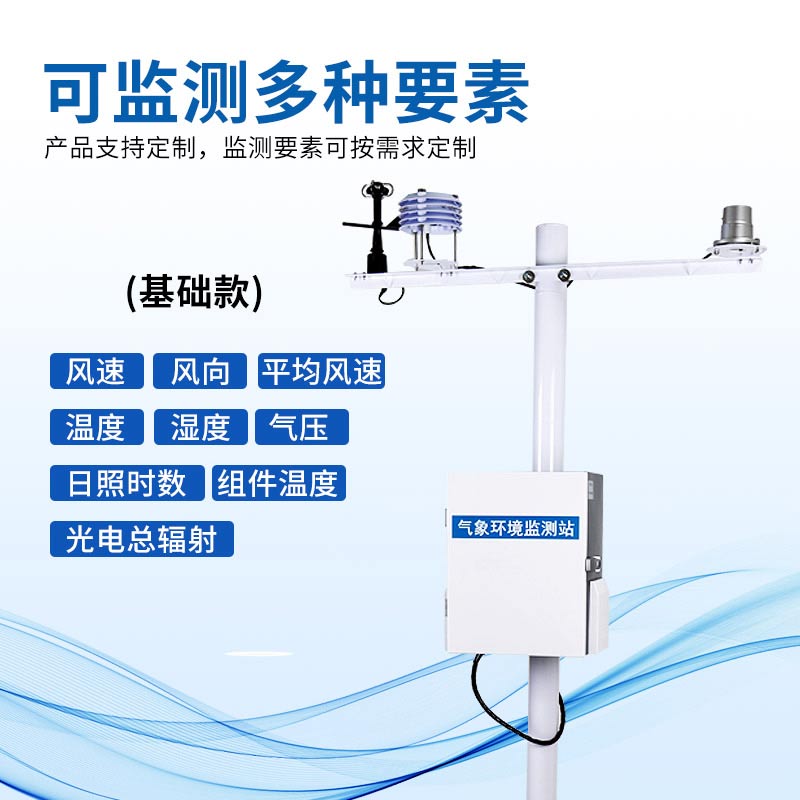
The Nine - element PV Weather Station is a meteorological monitoring device specifically designed for photovoltaic power generation systems.
Distributed photovoltaic power generation is mainly for self - consumption by users on the user side, and the surplus electricity is fed into the grid. The normal operation and data analysis of distributed photovoltaic power generation cannot do without a supporting monitoring system. This system can monitor key indicators such as total solar radiation, ambient temperature, wind speed and direction, and temperature of photovoltaic modules in real - time. It can be connected to a monitoring system to achieve data display, recording and analysis; it can also be connected to an inverter control system to assist in analyzing sensor data and ensure the efficient and stable operation of photovoltaic power stations.
There are three basic configurations of sensors:
Wind speed, wind direction, average wind speed, temperature, humidity, air pressure, total solar radiation, sunshine hours, module temperature;
Wind speed, wind direction, average wind speed, temperature, humidity, air pressure, total thermal radiation, daily cumulative total thermal radiation, total cumulative total thermal radiation, sunshine hours, module temperature;
Wind speed, wind direction, average wind speed, temperature, humidity, air pressure, total thermal radiation, daily cumulative total thermal radiation, total cumulative total thermal radiation, sunshine hours, module temperature.
This product strictly follows national standards, meets the requirements and logical relationships of data reported by photovoltaic power stations to provincial power dispatch, and has the ability to upgrade new parameters for the second time. A highly stable total solar radiation sensor is selected, with a perfect cosine characteristic, rapid response, zero offset, and a wide temperature response range, ensuring accurate and reliable radiation data. With years of experience in serving domestic and foreign photovoltaic power station users, the company has sufficient sensor inventory, a complete production line, mature debugging technology, all - round after - sales service, and fast logistics, providing a solid guarantee for product quality and service.
High-altitude migratory pests refer to a category of pests that rely on their own flight capabilities or high-altitude air currents to carry out long-distance and large-scale migrations during their growth and development. For example, the fall armyworm and the East Asian locust can fly at altitudes...
In outdoor natural settings such as dense forests, mountain streams, vast rivers, lakes and seas, and around rushing waterfalls, people often feel the air is exceptionally fresh. The key reason behind this is that the air in these places contains a sufficient amount of negative oxygen ions. Essentia...
The Life Detector Device, which fuses high-resolution thermal imaging with high-sensitivity audio, uses a 5-meter snake-tube probe to penetrate narrow crevices. In dark and complex environments, it clearly presents thermal images of the human body and captures weak audio signals such as breath...
Why Does Wind Power Generation Easily Encounter Icing Issues?First, wind farms are mostly located in areas with abundant wind resources such as mountains and coastal regions, where harsh climatic conditions (high humidity, low temperatures) easily lead to weather phenomena like clouds, fog, and free...


 Skype
Skype
 whatsapp
 mail
mail