Tianyi Sensor IOT Technology Co., Ltd
Sales Manager:Ms. Emily Wang
Cel,Whatsapp,Wechat:+86 15898932201
Email:info@fengtutec.com
Add:No. 155 Optoelectronic Industry Accelerator, Gaoxin District, Weifang, Shandong, China


Sales Manager:Ms. Emily Wang
Cel,Whatsapp,Wechat:+86 15898932201
Email:info@fengtutec.com
Add:No. 155 Optoelectronic Industry Accelerator, Gaoxin District, Weifang, Shandong, China
time:2025-09-08 09:03:27 source:Weather Station viewed:440 time
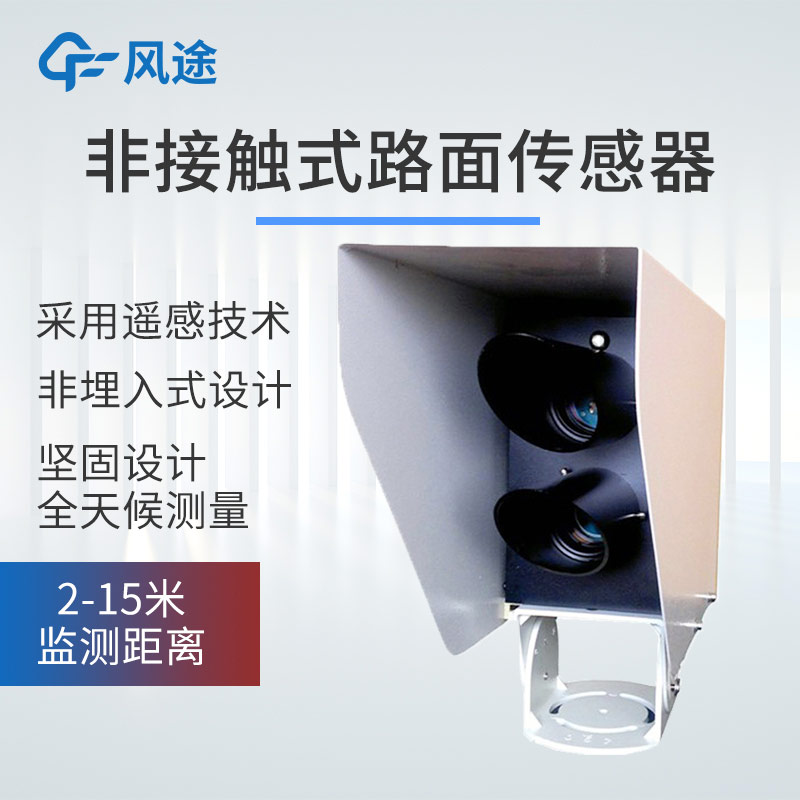
Compared with traditional embedded sensors, the Road Condition Sensor has obvious advantages in practical applications. It adopts non-intrusive installation, which does not require damaging the road structure. The installation process is simple and convenient, which can greatly reduce the impact of construction on traffic flow and ease road traffic pressure.
Relying on infrared remote sensing technology, this sensor can monitor road surface condition data in real time. Once abnormal conditions occur on the road surface, it can issue early warnings in a timely manner, providing timely guarantees for road management and traffic safety. It is capable of all-weather operation and is equipped with a heating and defogging function, which can cope with various severe weather conditions such as rain, snow, fog, and low temperatures. This ensures stable operation and continuous output of reliable data under different climatic conditions. Additionally, the sensor supports multi-parameter monitoring. Besides accurately detecting road conditions like icing, snow accumulation, and water accumulation, it can simultaneously monitor road surface temperature and weather phenomena such as fog, rain, and snow, providing comprehensive environmental data support for road management.
In terms of working mechanism, the core principle of this sensor lies in the fact that different substances have different reflection characteristics of infrared light. During operation, the sensor actively emits infrared light, then receives the spectral information reflected by the road surface, and analyzes this information. By comparing the reflection spectra of dry road surfaces with those covered by water, ice, snow, etc., it can accurately determine the current state of the road surface, including key information such as the degree of road slipperiness and the thickness of ice.
As a professional road surface condition measurement device, this sensor has flexible installation scenarios. It can be installed not only on existing weather stations but also on other buildings with an unobstructed view of the road surface. It has a built-in temperature measurement function, which can monitor the road surface temperature in real time and issue high-temperature alarms promptly when the road surface temperature is too high. The entire device is enclosed in an all-weather durable housing, featuring excellent resistance to harsh environments. Regardless of the weather conditions, it can stably provide data, supply important road slipperiness alarm information for the road meteorological information system, and help improve road traffic safety and management efficiency.
Debris flow is a common sudden geological disaster in mountainous areas. Triggered by heavy rains and melting snow and ice, it carries a large amount of solid materials such as sediment and rocks, flowing rapidly with strong impact force and a wide range of destruction. It often causes severe damage...
Water quality monitoring equipment for water treatment plants is an integrated system for online monitoring of key parameters such as residual chlorine, pH, water temperature, turbidity, and conductivity. It provides a basis for multi-dimensional testing of source water, treated water, and network water, and is widely used in full-process water quality safety management from water plants to end-users....
In the cold winter, transmission lines often face severe challenges of icing. When conditions such as low temperature, high humidity, and specific wind speed occur simultaneously, the phenomenon of icing on transmission lines is likely to form. Line icing not only increases the mechanical load on co...
Displacement monitor device utilizes harmless laser technology to accurately detect minute displacements in building structures such as walls and beams after disasters like earthquakes and explosions. By identifying even the slightest unstable movement, this equipment provides timely warnings...


 Skype
Skype
 whatsapp
 mail
mail