Tianyi Sensor IOT Technology Co., Ltd
Sales Manager:Ms. Emily Wang
Cel,Whatsapp,Wechat:+86 15898932201
Email:info@fengtutec.com
Add:No. 155 Optoelectronic Industry Accelerator, Gaoxin District, Weifang, Shandong, China


Sales Manager:Ms. Emily Wang
Cel,Whatsapp,Wechat:+86 15898932201
Email:info@fengtutec.com
Add:No. 155 Optoelectronic Industry Accelerator, Gaoxin District, Weifang, Shandong, China
time:2026-07-14 10:39:11 source:Weather Station viewed:31 time
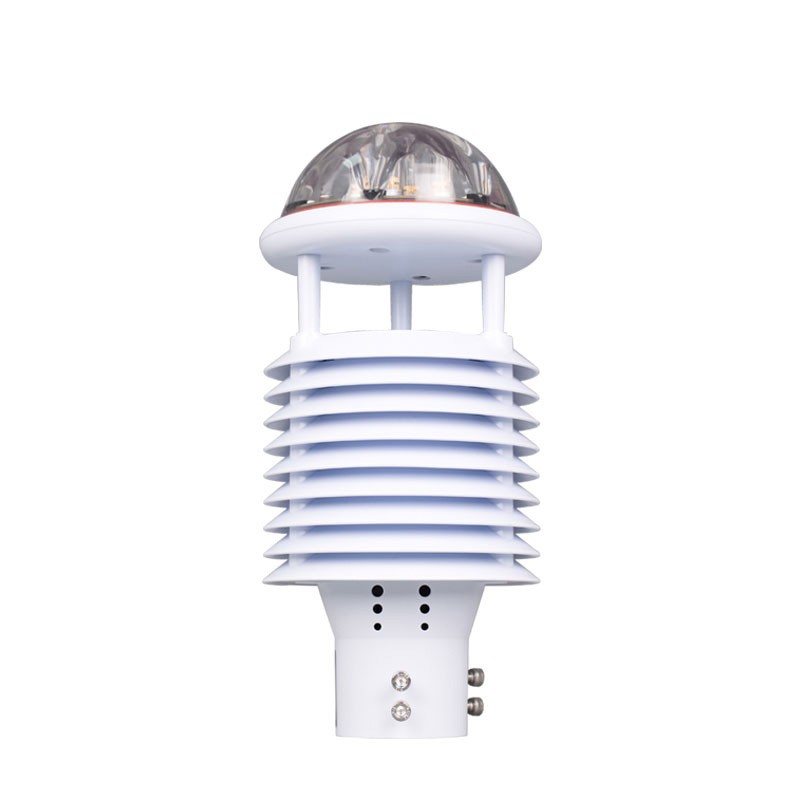
The wireless climate sensor integrates monitoring functions for 12 parameters: PM2.5, PM10, CO, SO2, NO2, O3, as well as temperature, humidity, wind speed and direction, atmospheric pressure, and optical rainfall. It uses ultrasonic wind measurement, has no starting wind speed limit, and comes standard with an RS485 interface, making it applicable to scenarios such as urban grid-based environmental monitoring, smart streetlights, and construction site dust monitoring.
This wireless climate sensor is a highly integrated instrument developed to meet air quality monitoring needs. It can simultaneously monitor six pollutant parameters (PM2.5, PM10, CO, SO2, NO2, O3) and 12 parameters (air temperature, air humidity, wind speed, wind direction, atmospheric pressure, and optical rainfall) 24/7. The main function of the device is to monitor conventional air pollutants and meteorological auxiliary parameters in real time, providing the analyzed data to environmental protection departments as a reference for air quality assessment and assisting in environmental decision-making. In addition, the device can be optionally equipped with monitoring parameters for hydrogen sulfide, volatile organic compounds, solar radiation, and noise.
For wind speed and direction measurement, the sensor employs a top-cover concealed ultrasonic probe design, effectively preventing rain and snow accumulation and natural wind obstruction. Its working principle involves emitting continuously variable frequency ultrasonic signals and detecting wind speed and direction by measuring the relative phase. This technology has no starting wind speed limitation and can operate normally under zero wind conditions. The equipment utilizes advanced sensing technology for real-time measurement, and its highly integrated design eliminates any moving parts, achieving zero-wear operation. The equipment features a watchdog circuit and automatic reset function, strong anti-interference capabilities, and stable operation in harsh environments.
The equipment casing is made of ASA engineering plastic, suitable for long-term outdoor use without discoloration. The product comes standard with an RS485 communication interface, supports the MODBUS protocol, and offers optional RS232, USB, or Ethernet interfaces for real-time data reading. A wireless transmission module is optional, with a minimum transmission interval of 1 minute. The probe uses a snap-fit design, solving the problem of loosening and inaccuracy during transportation and installation. The equipment is maintenance-free and requires no on-site calibration, significantly reducing subsequent maintenance costs.
Wireless climate sensors are applicable to various locations requiring air quality monitoring, including urban grid-based environmental monitoring, smart streetlights, scenic area environmental monitoring, dust monitoring at factories or mines and construction sites, urban roads, highways, and public places. In urban grid-based monitoring, the devices can be densely deployed across urban areas to form a high-density monitoring network, reflecting the spatial distribution and trends of air quality in real time. In construction site scenarios, the devices can continuously monitor dust pollution, providing data for construction dust control. Smart streetlight projects can integrate the devices into the light poles to achieve comprehensive monitoring of the urban road environment. By providing accurate pollutant and meteorological parameter data, the devices offer technical support for environmental management departments in pollution source tracing, early warning issuance, and governance decision-making.
The rain and water conditions refer to the changes in hydrological elements such as rainfall, river and reservoir water levels, and flow rates within a region. They serve as important bases for flood control and disaster reduction as well as water resource management. Measuring the rain and water co...
The standout advantage of the Portable Weather Station is its "portability," a feature directly reflected in its name. Compared with traditional fixed meteorological monitoring equipment, it has a significantly smaller size and lighter weight, with its overall design fully considering the...
Atmospheric Visibility Sensor is a meteorological monitoring device that calculates meteorological optical range (MOR) by measuring the intensity of light scattering from atmospheric particles. This article introduces a device that uses the forward scattering method, with a range of 2km and a...
The Landslide Early Warning and Monitoring System employs GNSS and Differential RTK technologies to acquire surface displacement data with millimeter-level precision. By integrating data such as displacement and rainfall, the system automatically issues early warning alerts without the need fo...


 Skype
Skype
 whatsapp
 mail
mail