Tianyi Sensor IOT Technology Co., Ltd
Sales Manager:Ms. Emily Wang
Cel,Whatsapp,Wechat:+86 15898932201
Email:info@fengtutec.com
Add:No. 155 Optoelectronic Industry Accelerator, Gaoxin District, Weifang, Shandong, China


Sales Manager:Ms. Emily Wang
Cel,Whatsapp,Wechat:+86 15898932201
Email:info@fengtutec.com
Add:No. 155 Optoelectronic Industry Accelerator, Gaoxin District, Weifang, Shandong, China
time:2025-03-11 09:41:15 source:Weather Station viewed:579 time
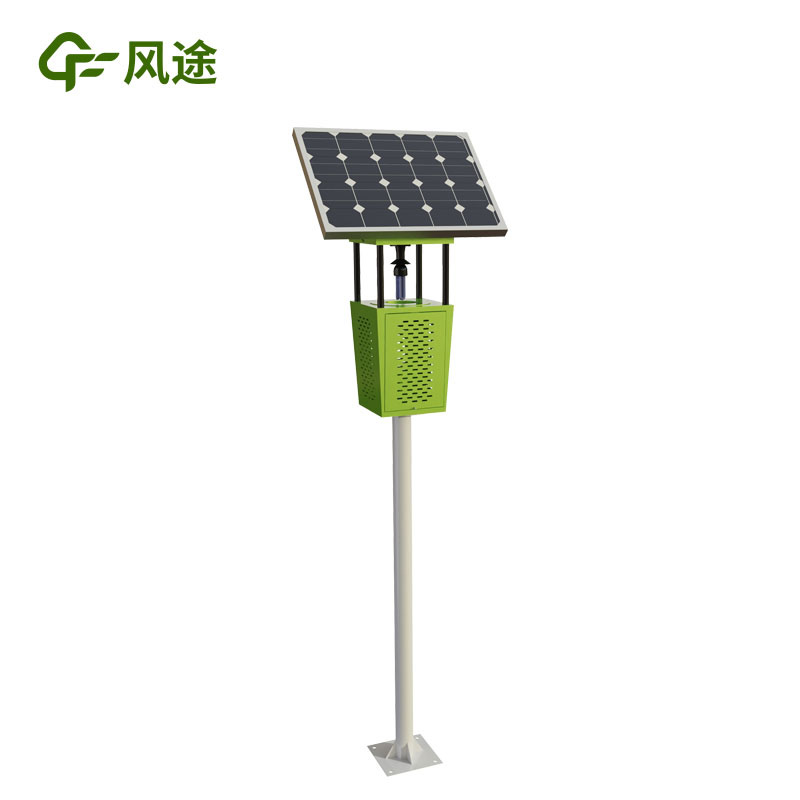
Entering the high - standard farmland demonstration area, 25 newly installed Solar insecticidal lamps are neatly arranged in the fields. These devices consist of silver lamp poles, black solar panels, and green lamp housings. They absorb solar energy and store electricity during the day, and at night, they use specific - band light to trap and kill pests. Each insecticidal lamp has an effective pest - killing range of 35 to 45 mu and can cover more than 1,200 mu of farmland.
The Solar insecticidal lamps in high - standard farmlands adopt physical control methods. Based on the phototaxis principle of insects, they can accurately trap and kill the adult insects of more than 10 species of agricultural pests, such as Lepidoptera, Coleoptera, Diptera, and Homoptera. This technology is characterized by easy operation, energy conservation and environmental protection, no pollution, and high pest - killing efficiency. It can significantly reduce the degree of pests in the fields and the amount of pesticide use.
According to the person in charge of the demonstration area, during the growth period of summer grains, the use of Solar insecticidal lamps for green pest control can reduce the number of pesticide applications by 3 to 4 times. This not only reduces agricultural production inputs and the risk of agricultural product pollution but also effectively saves energy and provides technical support for the sustainable development of agriculture. Through the continuous deployment of Solar insecticidal lamps, the demonstration area has achieved the goal of green yield increase and provided a demonstration model for the development of modern agriculture.
The application of this green prevention and control technology reflects the development trend of modern agriculture towards high - efficiency, environmental protection, and sustainability. It not only protects the farmland ecological environment but also provides reliable technical support for ensuring food security and improving the quality of agricultural products. With the advancement of agricultural modernization, green prevention and control technologies such as Solar insecticidal lamps will be promoted and applied on a wider scale, injecting new impetus into the green development of agriculture.
Vehicle-mounted weather instrument is a high-precision meteorological monitoring device designed for mobile platforms such as vehicles and ships. It can measure environmental temperature, relative humidity, wind speed, wind direction, atmospheric pressure, and piezoelectric rainfall data in real time....
Smart weather station is a highly integrated, low-power, and rapidly deployable automatic meteorological observation device. It can perform real-time and precise monitoring of wind speed, wind direction, temperature, humidity, atmospheric pressure, PM2.5, PM10, and noise, and features IoT clou...
The portable visibility monitor uses the forward scattering method to measure the total extinction coefficient of air and calculate visibility. Its integrated, portable design is compact and lightweight, making it widely applicable in emergency response, road traffic, and meteorological scenar...
These monitors calculate the total extinction coefficient using the forward scattering method. The device is portable and lightweight, equipped with a high-brightness touchscreen and data storage module. It boasts long battery life, strong protective features, and is suitable for visibility mo...


 Skype
Skype
 whatsapp
 mail
mail