Tianyi Sensor IOT Technology Co., Ltd
Sales Manager:Ms. Emily Wang
Cel,Whatsapp,Wechat:+86 15898932201
Email:info@fengtutec.com
Add:No. 155 Optoelectronic Industry Accelerator, Gaoxin District, Weifang, Shandong, China


Sales Manager:Ms. Emily Wang
Cel,Whatsapp,Wechat:+86 15898932201
Email:info@fengtutec.com
Add:No. 155 Optoelectronic Industry Accelerator, Gaoxin District, Weifang, Shandong, China
time:2026-06-29 10:45:26 source:Weather Station viewed:70 time
Life Detector Device is a vital sign detection device based on ultra-wideband radar technology. It can penetrate non-metallic obstacles such as brick walls and rubble, detecting stationary life forms at a distance of ≥26 meters and moving life forms at a distance of ≥36 meters. It features two-dimensional positioning and simultaneous multi-target detection capabilities, and is specifically designed for disaster relief sites such as earthquakes and landslides.
Life Detector Device is a vital sign detection device based on ultra-wideband radar technology. It transmits low-frequency electromagnetic waves to penetrate obstacles and capture micro-motion signals such as human breathing and heartbeat in real time. This device is mainly used for life detection in free space and through non-metallic media, to search for human survivors buried in collapsed buildings, rubble, and soil. Radar life detectors can detect signs of life by penetrating non-metallic obstacles with electromagnetic waves. Early single-dimensional radar could only determine the presence of life signs; currently, rescue operations mostly use two-dimensional radar, which displays two-dimensional images to understand the location, posture, and other information of trapped individuals.
The Life Detector Device system is developed using integrated low-power ultra-wideband radar technology and biomedical engineering technology. Employing multi-transmitter, multi-receiver imaging array technology, it can precisely locate living organisms within a given area. The device utilizes the reflection principle of radar electromagnetic waves, based on the Doppler effect generated by subtle movements such as human motion, breathing, heartbeat, and body swaying on continuous radar echoes, to analyze and determine the presence of living organisms in enclosed or invisible areas. In terms of penetration capability, the device can penetrate brick walls ≥50cm thick, detect stationary living organisms ≥26 meters, and moving living organisms ≥36 meters. The detection angle is ≥120°, and the wireless communication distance between the radar host and control terminal in open environments is ≥150 meters. The device has multi-target detection capabilities, capable of simultaneously detecting the motion and respiratory signals of ≥3 living organisms. The radar detection accuracy is ≥95%.
Regarding operation and display, Life Detector Device features two-dimensional positioning detection capabilities, displaying the detected target results on the screen using horizontal and vertical coordinates. The equipment automatically determines the presence of life within the detection area, displaying stationary and moving targets with different graphics. Users can select search modes for scenarios such as air, rubble, and wall penetration to optimize detection. The radar main unit (including battery) weighs ≤7.7kg, has a protection rating ≥IP67, and operates within a temperature range of -20℃ to +60℃. A single battery provides at least 12 hours of runtime, and two batteries are provided. The detector control tablet terminal has a screen ≥8 inches, allowing real-time viewing of the data collected by the device.
Life Detector Device is widely used in specialized industries such as firefighting, earthquake response, and emergency response. In disaster sites such as earthquakes and landslides, this equipment can quickly search for and locate surviving life, conduct large-scale searches for trapped personnel in collapsed buildings, quickly obtain signals from trapped individuals, and assist rescue personnel in rapidly deploying rescue operations. The equipment is capable of all-weather, all-day operation and is adaptable to harsh environments such as nighttime, rain, snow, fog, haze, and dust.
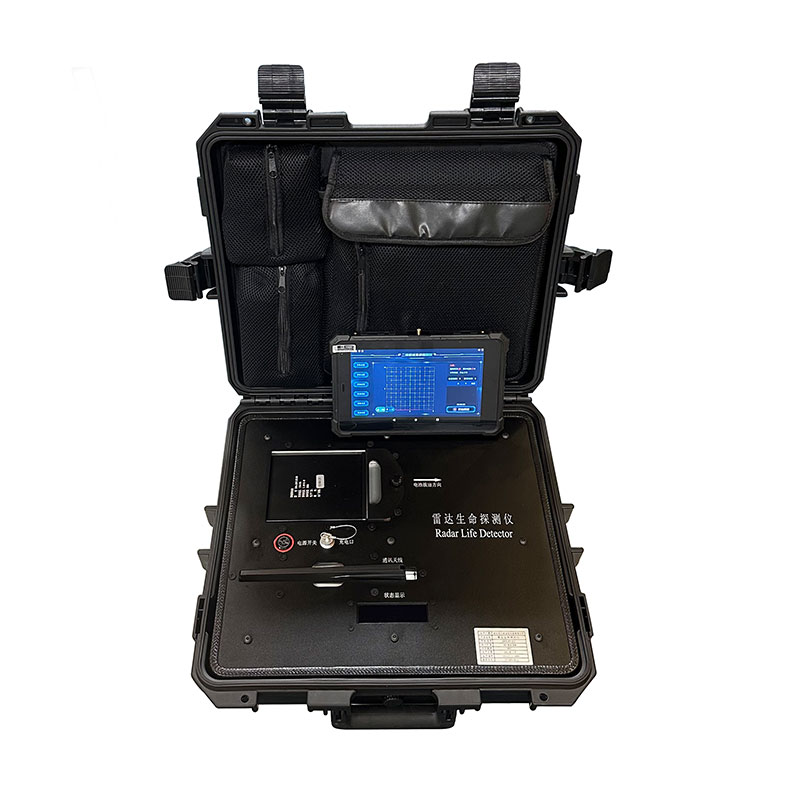
Life Detector Device is a vital sign detection device based on ultra-wideband radar technology. It can penetrate non-metallic obstacles such as brick walls and rubble, detecting stationary life forms at a distance of ≥26 meters and moving life forms at a distance of ≥36 meters. It features t...
This fully automated online hydrological monitoring device, based on K-band planar radar technology, can simultaneously measure water level, flow velocity, flow rate, and rainfall. Employing a non-contact measurement method, it is unaffected by silt and sewage corrosion. Its built-in intellige...
The Portable IV Curve Tester is a professional device used to measure the performance of photovoltaic (PV) cells. Its core testing purpose is to accurately evaluate key performance parameters of PV cells, such as conversion efficiency and output power, by obtaining the current-voltage (I-V) characte...
The problem of water pollution is serious. Governments, environmental protection agencies, and scientific research institutions need to promptly and accurately grasp the water quality status to formulate effective water resource protection and pollution control policies. However, the detection scope...


 Skype
Skype
 whatsapp
 mail
mail