Tianyi Sensor IOT Technology Co., Ltd
Sales Manager:Ms. Emily Wang
Cel,Whatsapp,Wechat:+86 15898932201
Email:info@fengtutec.com
Add:No. 155 Optoelectronic Industry Accelerator, Gaoxin District, Weifang, Shandong, China


Sales Manager:Ms. Emily Wang
Cel,Whatsapp,Wechat:+86 15898932201
Email:info@fengtutec.com
Add:No. 155 Optoelectronic Industry Accelerator, Gaoxin District, Weifang, Shandong, China
time:2026-06-23 10:58:47 source:Weather Station viewed:70 time
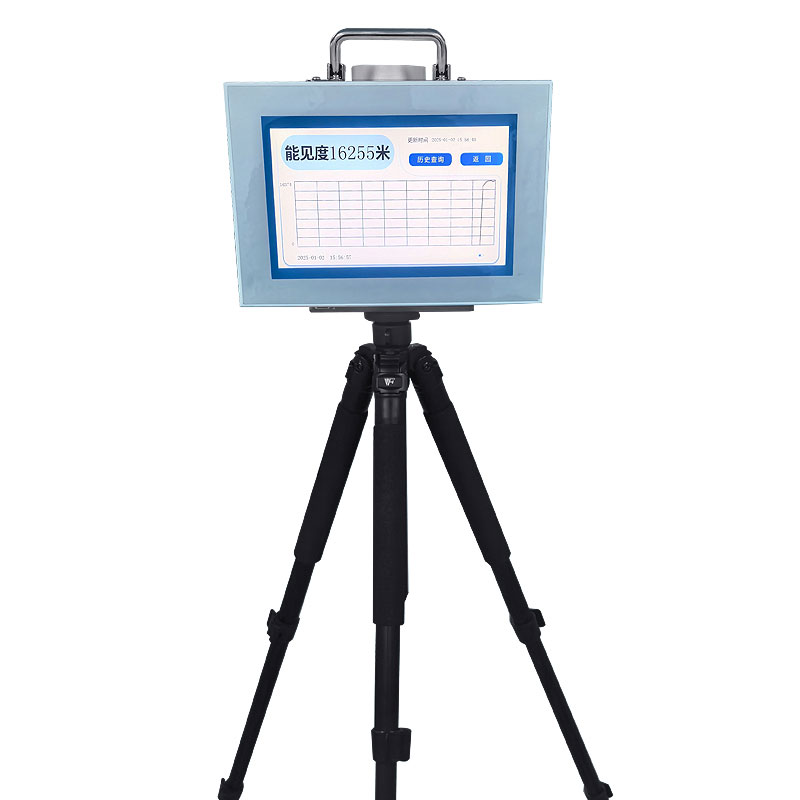
The visibility meter uses the forward scattering method to measure the total extinction coefficient of air and calculate the current visibility. It features an integrated, portable design, a high-brightness touchscreen, and built-in large-capacity storage. The entire unit is waterproof, dustproof, and shockproof, suitable for real-time visibility monitoring in scenarios such as road traffic, meteorological observation, and airport/navigation.
Visibility is a crucial meteorological element measuring atmospheric transparency, directly impacting the safe operation of various fields, including road traffic safety, aircraft takeoffs and landings, maritime navigation, and environmental monitoring. Low visibility weather conditions such as fog, haze, rain, and snow often lead to frequent traffic accidents, flight delays or cancellations, causing significant losses to people's lives and property, and to the social economy. As an instrument specifically designed to measure atmospheric visibility, the visibility meter calculates the visibility distance by measuring the attenuation or scattering intensity of light in the atmosphere, providing real-time meteorological data support for relevant industries.
Visibility meters generally use the forward scattering method as their core measurement principle. The instrument has a built-in infrared LED as its light source, emitting infrared light of a specific wavelength. When infrared light encounters aerosol particles in the air (such as fog droplets and dust), it is scattered. Within a certain range, the more tiny particles in the air, the greater the intensity of scattered light. The device detects the intensity of scattered light using a high-sensitivity detector, and after calculation by embedded software, converts the light scattering intensity into a standard visibility value. This principle ensures the accuracy and stability of the device's measurements under complex weather conditions.
In terms of technical performance, the visibility meter has a range of up to 80 kilometers and a resolution of 1 meter. Regarding measurement accuracy, the error is ±2% within ≤2km, ±5% within 2km-10km, and ±10% within >10km. The device has a short response time, enabling it to reflect changes in visibility in real time. The instrument casing is made of high-quality aluminum, providing excellent waterproof, dustproof, and impact-resistant performance. Both communication and power interfaces include surge protection, and a built-in watchdog circuit ensures reliable and stable operation during extended outdoor use. The device supports a wide voltage range of 1224V, with a total power consumption of approximately 1W, exhibiting extremely low power consumption and allowing for long-term power supply via solar panels or batteries. The digital interface uses RS485 or RS232, with the standard MODBUS protocol, requiring no protocol adaptation.
Visibility meters are widely used in road weather information systems, fog detection networks, offshore drilling platforms, airport weather systems, and other fields. In traffic management, they can be used to monitor visibility in areas such as highways, airport runways, and ports, providing decision-making support for traffic control, flight takeoffs and landings, and ship navigation. In meteorological observation, they serve as supplementary equipment to meteorological station networks, monitoring local visibility changes in real time. In environmental monitoring, they can be used to assess the impact of air pollution on visibility. Real-time monitoring and measurement of visibility can effectively ensure traffic safety and improve operational efficiency.
The Automatic Soil Monitoring System is a common device in modern precision agriculture and ecological environment monitoring. It provides reliable data for farmland irrigation, drought warning, and scientific research by measuring key parameters such as soil moisture, temperature, and electrical co...
As a professional monitoring tool specifically designed for the efficient operation of photovoltaic (PV) power plants, the Photovoltaic Weather Station features functional design, parameter selection, and data application that are deeply tailored to the actual needs of PV scenarios. It serves as a c...
In the development process of smart agriculture, various advanced technologies and equipment are continuously updating agricultural production modes. As a core tool, the soil moisture monitoring station is deeply integrating into the modern agricultural production system.Soil moisture, i.e., the soi...
Total Phosphorus Analyzer follows the HJ670-2013 ammonium molybdate spectrophotometric method. Water samples are digested under high temperature and pressure, and concentration is calculated through complexation color development and absorbance detection. The equipment offers stable accuracy,...


 Skype
Skype
 whatsapp
 mail
mail