Tianyi Sensor IOT Technology Co., Ltd
Sales Manager:Ms. Emily Wang
Cel,Whatsapp,Wechat:+86 15898932201
Email:info@fengtutec.com
Add:No. 155 Optoelectronic Industry Accelerator, Gaoxin District, Weifang, Shandong, China


Sales Manager:Ms. Emily Wang
Cel,Whatsapp,Wechat:+86 15898932201
Email:info@fengtutec.com
Add:No. 155 Optoelectronic Industry Accelerator, Gaoxin District, Weifang, Shandong, China
time:2026-05-06 13:17:11 source:Weather Station viewed:224 time
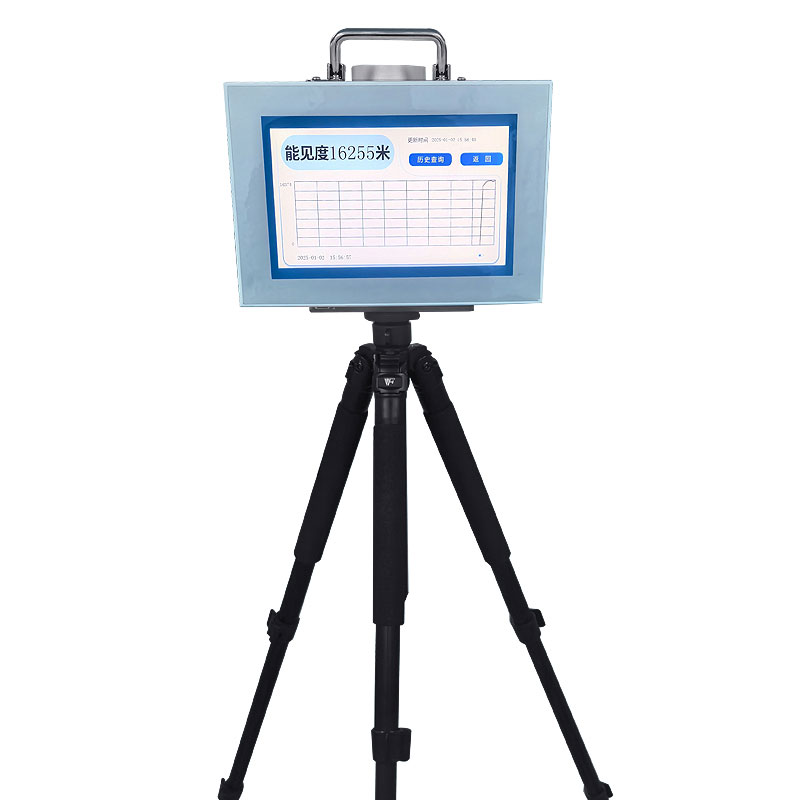
The Portable Visibility Monitor employs the forward scattering method to measure the total extinction coefficient of the air, offering a visibility range of up to 20 kilometers with a resolution of 1 meter. Compact and lightweight, the device is ready for immediate use upon power-up. It is widely applicable in scenarios requiring rapid assessment of regional visibility data—such as emergency response to disasters, road traffic patrols, meteorological observations, and temporary monitoring operations.
The Portable Visibility Monitor is a lightweight, highly integrated device designed for visibility monitoring. Utilizing the principle of optical forward scattering, it emits pulsed light via an infrared source and measures the intensity of the forward-scattered light within a specific angular range. By applying Mie scattering theory, it calculates the total extinction coefficient of the air in real-time to determine the current environmental visibility value. The instrument directly outputs visibility parameters, covering a measurement range of up to 20 kilometers with a minimum resolution of 1 meter. Measurement errors are controlled within ±2% for the 0–2 km range, ±5% for the 2–10 km range, and no more than ±10% for ranges exceeding 10 km. Since the sensor's core components are integrated within a tightly sealed sampling chamber—ensuring stable airflow—the device features a default data update frequency of one second. This capability allows it to rapidly capture real-time visibility values during low-visibility weather conditions (such as fog, haze, and dust storms), thereby preventing delays in analysis and decision-making caused by data lag.
The structural design of the Portable Visibility Monitor has been carefully optimized to meet the demands of outdoor mobile applications. The instrument's housing is constructed from high-strength engineering plastics or anodized aluminum alloy; with a total weight typically ranging between 2 and 5 kilograms, it can be easily carried and deployed on-site by a single individual. Select models are equipped with a 7-inch or 10.1-inch high-brightness touchscreen display that shows real-time visibility values and trend curves, with support for switching between Chinese and English interfaces. The built-in rechargeable lithium-ion battery module supports over 12 hours of continuous operation on a single charge, while certain models featuring an extended battery configuration can achieve up to 72 hours of runtime. The instrument requires no external calibration and becomes operational immediately upon being powered on; operators need only press the power button to obtain stable visibility readings within a very short timeframe. In terms of communication interfaces, the device comes standard with RS232, RS485, Bluetooth, and 4G wireless transmission modules, allowing monitoring data to be remotely viewed and managed via a mobile app and an IoT platform.
Portable visibility monitors demonstrate clear practical value in the fields of emergency management and transportation meteorology services. During sudden incidents—such as widespread smog, the rapid spread of wildfire smoke, or dust storms—emergency management agencies require immediate access to visibility conditions in the vicinity of the affected area. This information serves as a critical basis for making route decisions regarding the deployment of rescue vehicles, helicopters, and emergency supplies. Relying solely on a network of fixed meteorological stations in such situations may result in data gaps due to insufficient station density. Portable monitors, conversely, can be rapidly deployed by operators around emergency command centers, temporary landing zones, or critical traffic intersections, utilizing their built-in communication modules to transmit data back to the command center in real time. Similarly, in highway management scenarios, road patrol personnel can carry or temporarily set up these devices to acquire actual visibility data for specific road sections, thereby aiding in the decision-making process regarding the implementation of traffic control measures. Furthermore, these lightweight, calibration-free devices can be integrated into regional meteorological observation networks, offering significant potential for expanded applications in temporary scientific expeditions, short-term event support, and air quality assessments within urban communities that currently lack fixed monitoring station coverage.
This system employs a twelve-element integrated sensor to simultaneously monitor parameters such as wind speed, wind direction, temperature, humidity, air pressure, optical rainfall, and PM2.5, PM10, CO, NO2, SO2, and O3. The equipment requires no debugging, can be quickly deployed, and is sui...
A weather phenomenon sensor is an optical measuring instrument that uses the forward scattering principle. It emits an infrared pulse beam into the atmosphere and receives the scattering signals from aerosol particles, calculating the extinction coefficient to determine the visibility value. T...
Present weather and visibility sensor is a professional meteorological device used for automatically identifying and observing weather phenomena such as fog, rain, snow, mixed precipitation, and clear skies, and for measuring current visibility. It enables fully automatic and accurate recording of weather type, visibility, and precipitation....
instrument used to measure rainfall utilizes a three-channel narrowband infrared detector and a pure sine wave AC signal source to measure precipitation based on infrared optical principles. It supports the real-time scanning of raindrop size and count, offering a resolution of 0.01 mm, a rain...


 Skype
 whatsapp
 mail