Tianyi Sensor IOT Technology Co., Ltd
Sales Manager:Ms. Emily Wang
Cel,Whatsapp,Wechat:+86 15898932201
Email:info@fengtutec.com
Add:No. 155 Optoelectronic Industry Accelerator, Gaoxin District, Weifang, Shandong, China


Sales Manager:Ms. Emily Wang
Cel,Whatsapp,Wechat:+86 15898932201
Email:info@fengtutec.com
Add:No. 155 Optoelectronic Industry Accelerator, Gaoxin District, Weifang, Shandong, China
time:2026-05-18 11:15:55 source:Weather Station viewed:193 time
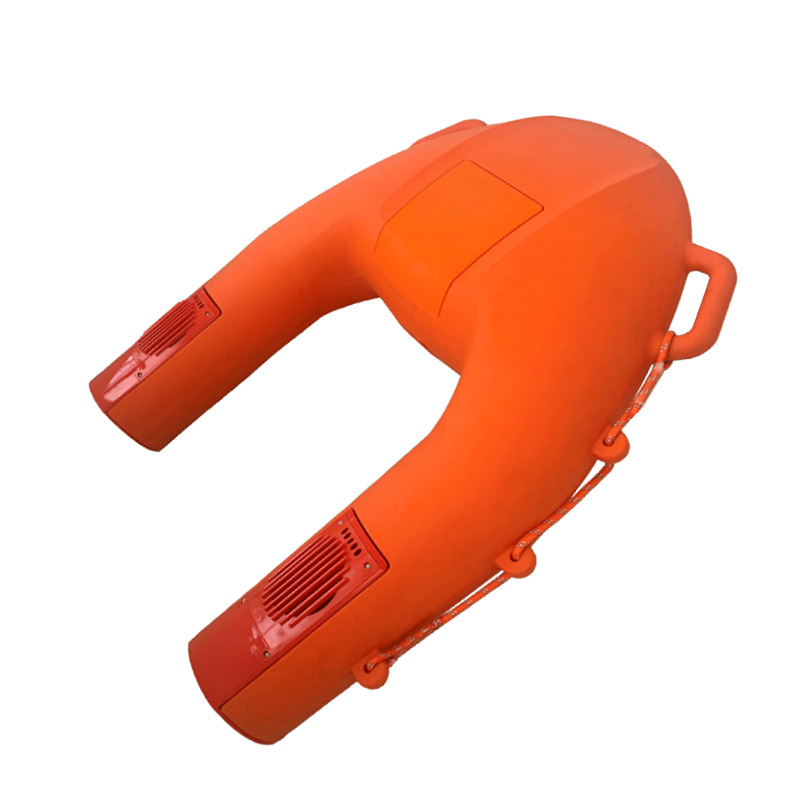
Water Rescue Equipment refers to a remotely controlled lifebuoy. Controlled wirelessly, it is powered by four ducted propulsion units, achieving an unloaded speed of 27 km/h. It supports one-key return and automatic return upon loss of contact, making it suitable for rescue operations in rivers, lakes, and coastal waters.
Water Rescue Equipment refers to a class of unmanned vessels that perform water-related tasks via wireless remote control, with the most common model being the remotely controlled lifebuoy. This device addresses the limitations of traditional lifebuoys, such as inaccurate throwing and limited rescue distance. Its power system consists of four ducted propulsion units, achieving an unloaded speed of 27 km/h and a speed of approximately 10 km/h with a person in the water, enabling it to quickly reach those in the water. The product is integrally molded from a long-life, UV-resistant, and oil-resistant rotational molding material. Its dimensions are no more than 1050mm x 980mm x 220mm, and its overall weight is kept under 16kg. It boasts an IP68 waterproof rating, supporting high-altitude drops from bridges up to 20 meters high or from drones. It automatically activates upon contact with water.
The Water Rescue Equipment intelligent control system integrates GPS and BeiDou dual positioning modules, supporting two core functions: one-key return and automatic return in case of connection loss. When the user triggers the one-key return command on the remote control, the device automatically returns to a radius of 1 meter from its starting position. If the signal between the remote control and the main unit is lost for more than 10 seconds, the device will also automatically trigger the return procedure, returning to the original deployment position. The battery management system has a built-in BMS protection board, providing overcharge, over-discharge, overcurrent, high-temperature, and short-circuit protection. The device is bidirectional, capable of independent navigation in both directions. If capsized by waves, it can automatically right itself and continue its mission. It is suitable for various water environments, including rivers, nearshore areas, lakes, and reservoirs.
In terms of structural safety, the equipment features safety guards at both the front and rear of the ducted propeller, with gaps between the guards controlled to 4-5 millimeters, preventing fingers from reaching the propeller blades and ensuring that a person in the water will not come into contact with rotating parts when gripping the equipment. Integrated handles are fitted on both sides of the fuselage, made of the same material as the fuselage, for the person in the water to grip. The remote control is designed for one-handed operation, and the screen displays real-time information such as equipment battery level, remote control battery level, communication signal quality, speed percentage, and control mode, allowing operators to remotely control the entire system from shore. The equipment also has nighttime operation capabilities; infrared strobe auxiliary lights installed on the fuselage provide visual positioning in low-visibility conditions, facilitating the identification of the equipment's location by rescuers.
In a practical application, during a water emergency rescue drill in Dongxihu District, Wuhan City, the operator precisely controlled a remote-controlled lifebuoy to quickly reach the simulated drowning person, efficiently completing the water rescue mission. A drowning prevention drill in Jinjing Town, Changsha County, demonstrated the collaborative operation of drones and intelligent lifebuoys. The drone located the person in the water from the air and transmitted images back in real time. An operator on shore then remotely controlled the lifebuoy to the rescue, completing the entire process from activation to successful rescue in just one minute. In a real rescue operation in the Minjiang River in Qianwei County, Sichuan Province, two people were trapped in the middle of the river due to exhaustion. Firefighters used an electric U-shaped lifebuoy and safely transferred both to shore within approximately five minutes. These cases validate the practical effectiveness of this equipment in water rescue.
Water quality monitoring equipment for water treatment plants is an integrated system for online monitoring of key parameters such as residual chlorine, pH, water temperature, turbidity, and conductivity. It provides a basis for multi-dimensional testing of source water, treated water, and network water, and is widely used in full-process water quality safety management from water plants to end-users....
TianYi® EL Detector [Model: FT-EL1] Partial Parameters:Detectable Defect Types: Cracks, broken cells, fragments, broken grids, black core, poor soldering, process contamination, low-efficiency cells, black edge, over-firing, over-etching, perforations.Camera: 20-megapixel; Resolution: 4...
Microwaves refer to electromagnetic waves with frequencies ranging from 300MHz to 300GHz and wavelengths from 1 millimeter to 1 meter. Due to their high frequency and short wavelength, they have strong directivity and penetrating power, enabling stable propagation under different meteorological cond...
The 3D ultrasonic anemometer utilizes ultrasonic measurement technology and features an all-metal construction devoid of any moving parts; it is capable of simultaneously measuring wind direction in both horizontal and vertical planes while outputting wind speed components along the X, Y, and...


 Skype
Skype
 whatsapp
 mail
mail